

AG Magazine • Fitness & Performance
If you only had 3 minutes for mobility, here is exactly what to do. And here is the part that surprises most people: 3 minutes of targeted movement, repeated several times throughout the day, produces measurably better flexibility and metabolic outcomes than a single 30-minute stretching session tacked on at the end of a workout.
Movement snacks — brief, structured physical activity breaks distributed throughout the day — are one of the most evidence-supported interventions in current exercise science. A 2023 systematic review in the British Journal of Sports Medicine analysed 17 studies on exercise snacking and sedentary interruption, finding that distributed movement breaks produced equal or superior outcomes for postprandial glucose control, cardiovascular markers, and aerobic capacity compared to single continuous exercise sessions of equivalent total duration. The mechanism is simple and powerful: frequency beats duration when the goal is daily physiological maintenance.
Get more like this — weekly.
One email a week. Research-backed wellness, translated into things you can actually do. No spam.
Most people know they should move more. The barrier is not motivation — it is architecture. A 60-minute mobility routine is a scheduling problem. Three minutes, three times a day, attached to things you already do, is a habit design problem — and that is a much easier one to solve.
This article gives you the science, the 3-stretch reset protocol, and the exact habit-stacking framework that turns daily mobility from an aspiration into an automatic behaviour.
What Are Movement Snacks and Why Do They Work?
Movement snacks are short bouts of physical activity — typically 2 to 5 minutes — performed multiple times throughout the day rather than consolidated into one longer session. They work by repeatedly interrupting the metabolic suppression that prolonged sitting causes, triggering glucose uptake, maintaining joint lubrication, and activating the postural muscles that desk work systematically deactivates.
The physiological case is specific. Within 20–30 minutes of continuous sitting, lipoprotein lipase — the enzyme responsible for fat metabolism — begins to downregulate in the legs. Muscle contractions are one of the primary triggers for its activity. Without them, circulating triglycerides rise and insulin sensitivity declines, as documented in foundational research published in Diabetologia as early as 2012. This metabolic shift begins within a single prolonged sitting bout — not over weeks or months. Movement snacks interrupt the cycle before it takes hold.
What are the benefits of movement snacks throughout the day?
The benefits documented across the movement snack literature span four domains. Metabolic: blood sugar spikes after meals are reduced by 58% more with three 10-minute distributed walks than with one 30-minute continuous walk, according to a study published in Diabetologia. Cognitive: five-minute walking breaks every hour improve attention, executive function, and mood significantly more than unbroken sitting, regardless of prior exercise, as confirmed by research in the Journal of Science and Medicine in Sport. Musculoskeletal: joint lubrication, hip flexor length, and thoracic mobility all degrade with sustained static posture — and respond rapidly to brief, targeted movement. Cardiovascular: the World Health Organization’s physical activity guidelines now recognise that accumulating physical activity in short bouts throughout the day contributes meaningfully to the 150-minute weekly moderate-intensity target.
Can movement snacks replace a workout?
Not entirely — but they serve a fundamentally different physiological role. A structured training session builds capacity: strength, aerobic fitness, hypertrophy. Movement snacks maintain the metabolic and musculoskeletal environment that makes that capacity accessible and recoverable. Think of it this way: your gym session is where you build the engine. Movement snacks keep it running cleanly between services. Both are necessary. Neither replaces the other.
The 3-Stretch Reset: Your Daily Mobility Protocol
The 3-stretch reset is designed around one principle: maximum physiological return per minute of investment, targeting the three movement patterns most consistently impaired by sedentary work postures. Each stretch takes 60–90 seconds. The complete reset takes under 3 minutes. It requires no equipment, no floor space beyond a standing position, and no change of clothing.
Perform the 3-stretch reset a minimum of three times per day — ideally four to six times, attached to existing daily triggers. The goal is not flexibility for its own sake. It is the restoration of joint range of motion and neuromuscular activation that desk work progressively removes.
The 3-stretch reset: step-by-step protocol
- Standing Hip Flexor Lunge (60 seconds each side): Step one foot forward into a lunge, lower the back knee toward the floor, and drive the hips forward until you feel a deep stretch through the front of the rear hip. Hold for 30 seconds per side without bouncing. This directly targets the psoas and iliacus — the hip flexors that shorten in sustained sitting and are the primary postural victim of desk-based work. According to the Cleveland Clinic’s musculoskeletal health resources, chronic hip flexor tightness is one of the leading contributors to lower back pain in desk workers — the most prevalent musculoskeletal complaint globally.
- Doorway Chest Opener (45–60 seconds): Place both forearms on a door frame at shoulder height, step one foot through the doorway, and lean forward gently until you feel the stretch across your chest and the front of your shoulders. This restores thoracic extension and pectoral length lost to the sustained forward-rounded posture of keyboard and screen work. The Mayo Clinic’s posture and ergonomics guidance identifies upper-body forward posture as a primary driver of neck pain, shoulder impingement, and headaches in office populations.
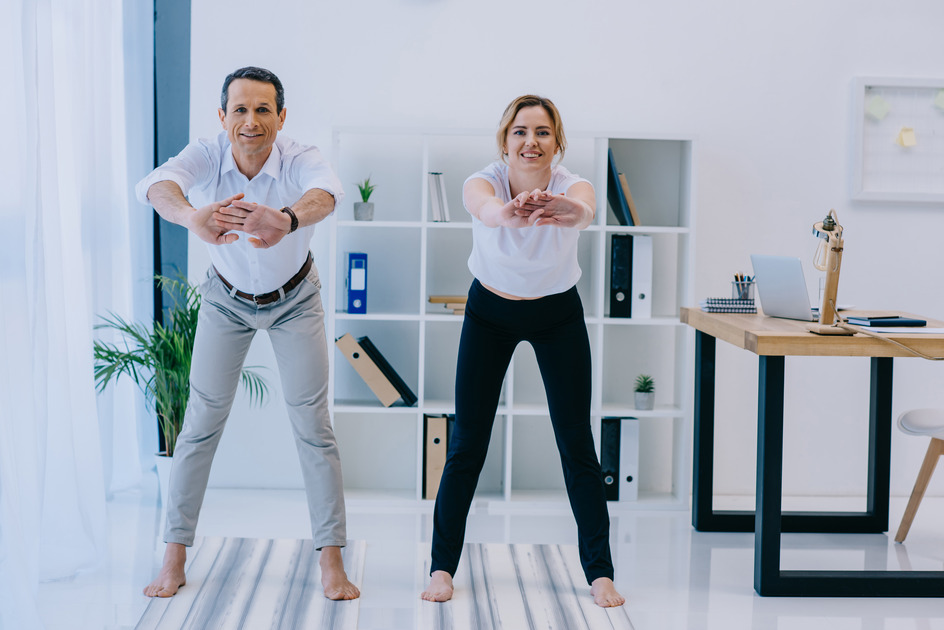
- Standing Thoracic Rotation (30 seconds each side): Stand with feet shoulder-width apart, place both hands on your lower back or cross them over your chest, and rotate your upper body as far as comfortable to each side, holding for 2–3 seconds at end range. This restores rotational mobility in the thoracic spine — the segment most immobilised by sustained sitting — and activates the deep spinal stabilisers that deactivate in static postures. The National Institute of Neurological Disorders and Stroke identifies thoracic mobility restriction as a significant contributor to low back pain by forcing the lumbar spine to compensate for movement it should not be performing.
⚡ PRO TIP
Perform the standing hip flexor lunge immediately after your postprandial glucose peak — approximately 30–45 minutes after eating. Muscle contractions in the legs during this window directly stimulate GLUT-4 glucose transporters in muscle cells, accelerating glucose uptake from the bloodstream and reducing the postprandial spike. A single 2–3 minute movement snack during this window produces a measurable reduction in blood sugar elevation. Combining it with the thoracic rotation maximises the anti-inflammatory benefit by activating the deep spinal musculature that sedentary posture suppresses throughout the day. This is the one time-of-day cue that makes the 3-stretch reset simultaneously a metabolic intervention and a mobility tool, not just a stretch.
The Habit-Stacking Framework: How to Make Movement Snacks Automatic
The research on long-term adherence to movement snacks consistently identifies the same failure point: timer-based reminders. An alarm that interrupts your workflow generates friction, resentment, and eventual dismissal. The more effective approach is habit stacking — attaching the movement snack to an existing reliable daily trigger that already occurs without conscious effort. Stanford behavioural scientist BJ Fogg’s research on behaviour design shows that attaching a new behaviour to an existing cue produces significantly higher long-term adherence than alarm-based or willpower-based approaches. The trigger is already there. You are adding a movement layer to something you already do reliably.
What are the best daily triggers for movement snacks?
Anchor the 3-stretch reset to triggers that already occur predictably across your working day:
- After every video call ends: Stand up before you open the next task. The natural transition between meetings is the most reliable available trigger for most knowledge workers.
- Before your first coffee of the day: The kettle-boiling window is exactly 2–3 minutes. Use it. The morning hip flexor stretch before caffeine primes the postural system that the day’s sitting will progressively compromise.
- 30–45 minutes after lunch: The postprandial window (see Pro Tip). This is the highest-leverage metabolic timing for the movement snack and the easiest post-meal trigger to build around.
- Before sitting down at your desk after a bathroom break: You are already standing. Three minutes of the 3-stretch reset before you sit is zero additional friction.
How long does it take to build a movement snack habit?
The NIH’s behavioral research resources note that habit formation timelines vary widely by individual and behaviour complexity, but research consistently shows that simple, context-anchored behaviours — those attached to existing environmental cues rather than relying on memory or motivation — stabilise significantly faster than willpower-dependent ones. For a behaviour as brief and low-barrier as the 3-stretch reset, consistent daily practice anchored to two or three reliable triggers typically produces automaticity within 14–21 days. The critical variable is not frequency of intention. It is frequency of execution.
Scaling the 3-Stretch Reset: From Minimum Dose to Full Protocol
The 3-stretch reset is a minimum effective dose — three movements that address the three most consistently impaired patterns in desk-based adults. Once the habit is established, it becomes the foundation for a more comprehensive daily mobility practice that adds layers without requiring dedicated session time.
How do I progress movement snacks beyond the basic 3 stretches?
Progress in two dimensions: variety and volume. Once the three anchor stretches are automatic, rotate in additional movement patterns that target secondary restrictions. The most evidence-supported additions for desk workers:
- Calf raises (30 reps, standing): Activates the calf muscle pump that assists venous return — directly counteracting the blood pooling associated with prolonged sitting. Takes 45 seconds and can be performed anywhere, including in a queue or during a phone call.
- Wall angels (10–12 reps): Stand with your back against a wall, arms at 90 degrees, and slowly raise and lower them while maintaining contact with the wall. Restores scapular mobility and mid-back activation that forward-posture work suppresses.
- 90–90 hip stretch (60 seconds each side): Seated or floor-based figure-four stretch targeting hip external rotation — the complementary movement to the hip flexor lunge. Together, they address both the anterior and posterior hip capsule.
A fully developed movement snack practice — five to six times per day, three to five minutes each — accumulates 15–30 minutes of targeted mobility work daily without a single dedicated session. According to the
ACSM’s flexibility training guidelines, adults should perform flexibility exercises for all major muscle groups at least 2–3 days per week — a target this protocol meets and exceeds with zero scheduling overhead.
Start the Reset Before You Finish Reading This
Movement snacks are not a soft alternative to structured training. They are the maintenance layer that keeps your body mobile, metabolically active, and structurally sound between the sessions that build your fitness. Three minutes, three times a day. That is the minimum investment for measurable daily mobility benefit — and the research is unambiguous that it works.
The motivational reframe is this: you do not need more time in your day to move better. You need to reclaim the time you are already spending transitioning between sedentary tasks. Every meeting that ends, every kettle that boils, every post-lunch walk to the kitchen is a movement snack waiting to happen. The 3-stretch reset gives it structure.
Stand up right now. Perform the standing hip flexor lunge — 30 seconds each side. That is your first movement snack of the day. Tomorrow, add the chest opener. The day after, complete the full 3-stretch reset. By the end of the week, you will have performed more targeted mobility work than most people achieve in a month of sporadic stretching. Bookmark the ACSM’s physical activity guidelines for the full flexibility recommendations, and build from the reset outward.



No one seems to have shared their thoughts on this topic yet
Leave a comment so your voice will be heard first.