
AG Magazine • Fitness & Performance
The fitness industry spent decades selling you a mirror. Bigger arms. Leaner abs. A physique that signals effort in the summer. That framing is losing ground — not to a wellness trend, but to a body of scientific evidence that has quietly reordered the case for lifting weights entirely.
Strength training for longevity is now the fastest-growing segment of the resistance training conversation among researchers, clinicians, and increasingly, the people walking into gyms. The shift is not cosmetic. It is physiological. A landmark 2022 study in the British Journal of Sports Medicine, drawing on data from nearly 100,000 adults, found that regular muscle-strengthening activity was independently associated with a 10–17% reduction in all-cause mortality, cardiovascular disease mortality, and cancer mortality — effects that held even after controlling for aerobic exercise bjsm.bmj.com.
That finding reframes what the barbell is for. Not a tool for sculpting appearance. A tool for extending the years in which you move, recover, think, and function without assistance. For the health-conscious achiever who trains but has not explicitly framed their resistance work around longevity outcomes, this article provides the science, the specific adaptations that matter most, and the training adjustments that maximise them.
Why Muscle Mass Is a Longevity Biomarker, Not an Aesthetic One
Lean muscle mass is emerging in clinical research as one of the most reliable predictors of long-term health outcomes — independent of body weight, BMI, or cardiovascular fitness. This reframe has significant practical implications for how you think about training goals.
Sarcopenia: The Silent Decline That Starts at 35
Sarcopenia — the progressive loss of skeletal muscle mass and strength with age — begins measurably in the mid-thirties, with adults losing approximately 3–8% of muscle mass per decade from age 30, accelerating to 15% per decade after 70 nia.nih.gov. The consequences are not primarily aesthetic. Muscle is metabolically active tissue that governs insulin sensitivity, resting energy expenditure, postural stability, and the structural reserve that determines how well you survive acute illness, falls, or surgical recovery.
The National Institute on Aging identifies sarcopenia as a primary driver of functional decline, loss of independence, and increased all-cause mortality in older adults nia.nih.gov. Every kilogram of lean mass you maintain into your fifties and sixties is a direct investment in the physiological reserve that protects your health span — the years of life spent in good health — not just your lifespan.
Grip Strength as a Mortality Predictor
One of the most striking findings in longevity research is how strongly grip strength — a proxy for total body muscle strength — predicts survival outcomes. A 2015 study published in The Lancet analysed grip strength data from 140,000 adults across 17 countries and found it was a stronger predictor of cardiovascular disease mortality than systolic blood pressure thelancet.com. Weak grip strength in midlife corresponded to higher rates of heart attack, stroke, and all-cause death across the entire follow-up period.
This is not a correlation quirk. Grip strength reflects total neuromuscular system integrity — the strength of connective tissue, the efficiency of motor unit recruitment, and the metabolic health of muscle tissue broadly. It is, in the most practical sense, a readout of how well your musculoskeletal system is ageing. And it is directly trainable.
The Specific Adaptations That Longevity Training Targets
Not all strength training produces the same longevity-relevant adaptations. A programme optimised for hypertrophy aesthetics and a programme optimised for functional longevity share foundational principles but diverge in emphasis, intensity distribution, and movement selection. Understanding which adaptations matter most for health span lets you programme more precisely.
Mitochondrial Density and Metabolic Resilience
Resistance training increases mitochondrial density in skeletal muscle — a finding that contradicts the outdated assumption that only aerobic exercise drives mitochondrial adaptation. A 2023 review in the Journal of Physiology confirmed that progressive resistance training, particularly at moderate-to-high volume, produces significant increases in mitochondrial content, respiratory capacity, and oxidative enzyme activity in trained muscle fibres physoc.onlinelibrary.wiley.com. Denser mitochondria mean more efficient energy production, better insulin sensitivity, and reduced oxidative stress accumulation — three of the most clinically significant drivers of metabolic ageing.
Bone Mineral Density: The Under-Discussed Benefit
Osteoporosis affects an estimated 200 million people globally and is directly implicated in the hip fractures and vertebral compression events that represent catastrophic health events in older adults. Progressive resistance training is the most effective non-pharmacological intervention for maintaining and increasing bone mineral density across the lifespan. The National Osteoporosis Foundation recommends weight-bearing and muscle-strengthening exercises as a primary prevention strategy, citing evidence that resistance training can increase bone density by 1–3% per year in adults who have already begun losing it bonehealthandosteoporosis.org.
This is a compounding investment. Every year you build and maintain bone density through consistent resistance training reduces your fracture risk at the decade when that risk becomes life-altering. You are not just getting stronger. You are building structural resilience against one of ageing’s most acute threats.
Insulin Sensitivity and Metabolic Disease Prevention
Skeletal muscle is the primary site of post-meal glucose disposal — responsible for clearing approximately 80% of the glucose that enters your bloodstream after eating [6]. More muscle mass means greater glucose clearance capacity, lower postprandial blood sugar spikes, and reduced chronic insulin demand. A 2021 systematic review published by the American Diabetes Association found that resistance training improved insulin sensitivity by an average of 16–25% in adults with or at risk for type 2 diabetes, with larger effects in those with the greatest baseline muscle deficit diabetes.org.
⚡ PRO TIP
Track grip strength as a quarterly longevity biomarker, not just a warm-up metric. Use a hand dynamometer (under £20) and record your dominant and non-dominant hand peak force. Research from the Gerontological Society of America identifies a grip strength decline of more than 5 kg over 12 months in adults under 60 as an early warning signal of accelerated biological ageing and a prompt for dietary protein review, sleep assessment, and training load audit. A single number, measured four times per year, gives you an objective leading indicator of how well your strength training programme is maintaining your musculoskeletal system — far more actionable than a mirror.
How to Structure a Longevity-Focused Strength Programme
Longevity-focused strength training is not softer, lighter, or less demanding than aesthetics-focused training. The difference is in what you optimise for: functional movement patterns over isolation exercises, consistent progressive overload over periodic volume spikes, and joint health preservation over maximum short-term load accumulation.
The Four Movement Patterns That Matter Most
A longevity-oriented programme anchors every session in the four compound movement patterns with the highest functional transfer to daily life and the strongest evidence base for long-term musculoskeletal health:
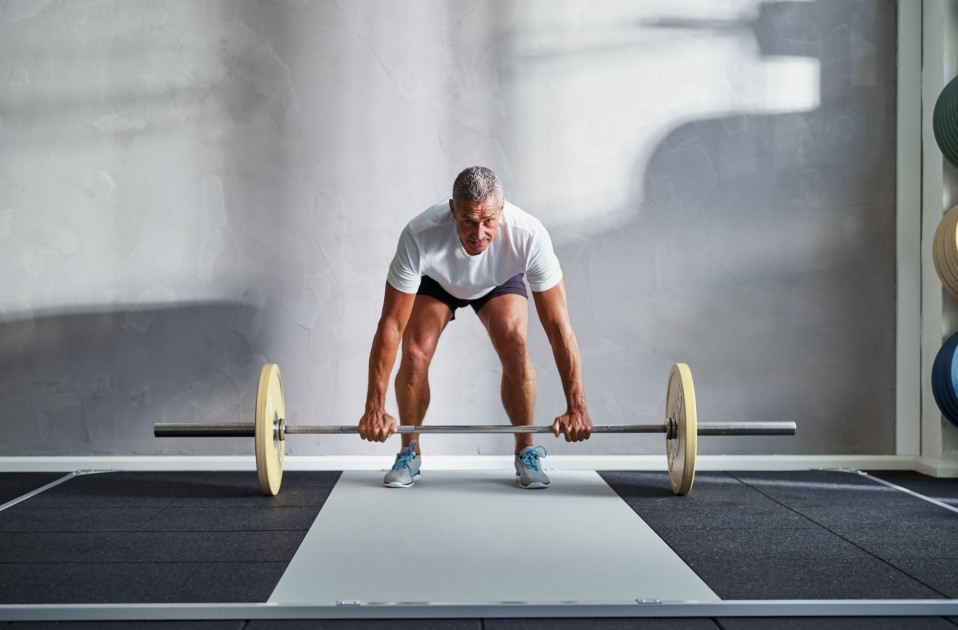
- Hip hinge (deadlift, Romanian deadlift, kettlebell swing): Trains posterior chain strength, lumbar stability, and hip extension power — the movement pattern most predictive of independent mobility in older adults.
- Squat pattern (goblet squat, front squat, split squat): Develops quadriceps, glutes, and knee stability. Single-leg variants are particularly valuable for balance and unilateral strength that transfers to fall prevention.
- Horizontal push and pull (bench press, row): Maintains shoulder girdle health, thoracic extension mobility, and upper body postural integrity — which degrades rapidly with desk-based lifestyles.
- Carry and loaded movement (farmer’s carry, suitcase carry): Develops grip strength, core anti-lateral flexion strength, and gait stability under load — directly relevant to the functional tasks of daily life at any age.
Loading Parameters for Longevity
The ACSM’s resistance training guidelines for adults recommend 2–4 sessions per week at 60–80% of one-repetition maximum for the primary compound movements, with a minimum of 48 hours between sessions targeting the same muscle groups acsm.org. For longevity-specific goals, progressive overload remains the non-negotiable principle — the adaptation stimulus must increase over time or the musculoskeletal system will not continue adapting. However, the intensity ceiling should be managed more conservatively than in aesthetic or competitive programmes: training to 1–2 reps from technical failure, rather than muscular failure, preserves joint health and training consistency across decades.
The Role of Protein in Supporting Longevity Training
Muscle protein synthesis — the process by which training stimulus is converted into structural muscle adaptation — requires adequate dietary protein, and the threshold for older adults is higher than the amounts most people consume. The Harvard T.H. Chan School of Public Health’s nutrition resources, referencing multiple meta-analyses, recommend 1.2–1.6 grams of protein per kilogram of body weight per day for adults over 40 engaged in regular resistance training — significantly above the standard RDA of 0.8g/kg that reflects minimum sufficiency, not training-optimised muscle maintenance harvard Health.
The Mindset Shift: Training for the Person You Will Be at 70
Here is the reframe that changes how every training decision feels. Every session you complete is not just improving how you perform this week. It is making a deposit into the physiological account that determines your functional independence, cognitive sharpness, and physical capability in your seventh, eighth, and ninth decades.
The research on this is not ambiguous. A 2019 study in the British Medical Journal followed adults over 40 for 18 years and found that those who maintained regular strength training had a 46% lower risk of all-cause mortality, a 41% lower risk of cardiac death, and significantly better preservation of cognitive function into their seventies compared to sedentary controls bjsm.bmj.com. The mechanism is not mysterious: muscle mass maintains metabolic health, bone density prevents catastrophic fracture, neuromuscular efficiency preserves balance and fall prevention, and the systemic anti-inflammatory effect of regular resistance training reduces the chronic low-grade inflammation that accelerates virtually every age-related disease process.
What would it mean to be genuinely strong at 70? To carry your own bags, climb stairs without a handrail, recover from illness in days rather than weeks, and maintain the cognitive performance that sustained aerobic and muscular fitness demonstrably protects? That is the actual goal of longevity-focused strength training — and it begins with the session you do this week.
Getting Started: Your Longevity Strength Baseline
If you currently train for aesthetics and want to shift your programming toward longevity outcomes, you do not need to scrap your existing programme. You need to audit it against three questions:
- Are all four fundamental movement patterns — hip hinge, squat, push/pull, carry — represented at least once per week at progressive loading?
- Is your protein intake at 1.2–1.6g/kg of body weight daily, specifically prioritising leucine-rich sources at each main meal to maximise muscle protein synthesis?
- Are you tracking grip strength quarterly as an objective longevity biomarker, and is it stable or improving year-over-year?
If the answer to all three is yes, your current programme is already serving your longevity goals, whether you framed it that way or not. If any are missing, those are your first three adjustments — and they cost no additional training time.
Train for the Body That Carries You Through Life
The cultural shift from training for aesthetics to training for longevity is not a retreat from ambition. It is an upgrade in the ambition’s time horizon. Building a body that performs and endures across decades requires the same discipline, progressive overload, and consistency that building an aesthetic physique requires — the difference is that the longevity goal compounds in ways that the mirror cannot capture.
The motivational reframe is this: strength training for longevity is not something you do instead of training hard. It is the reason that training hard continues to make sense past the point where aesthetics alone would have diminished the motivation. Your future self’s physical independence is the most personal performance goal you have.
This week, complete the three-question audit above. Add a farmer’s carry to your next session if you have not been doing one. Measure your grip strength and record the baseline. Then programme your next four weeks with one explicit longevity goal alongside your existing training targets. The science does not just support this shift — it insists on it.