

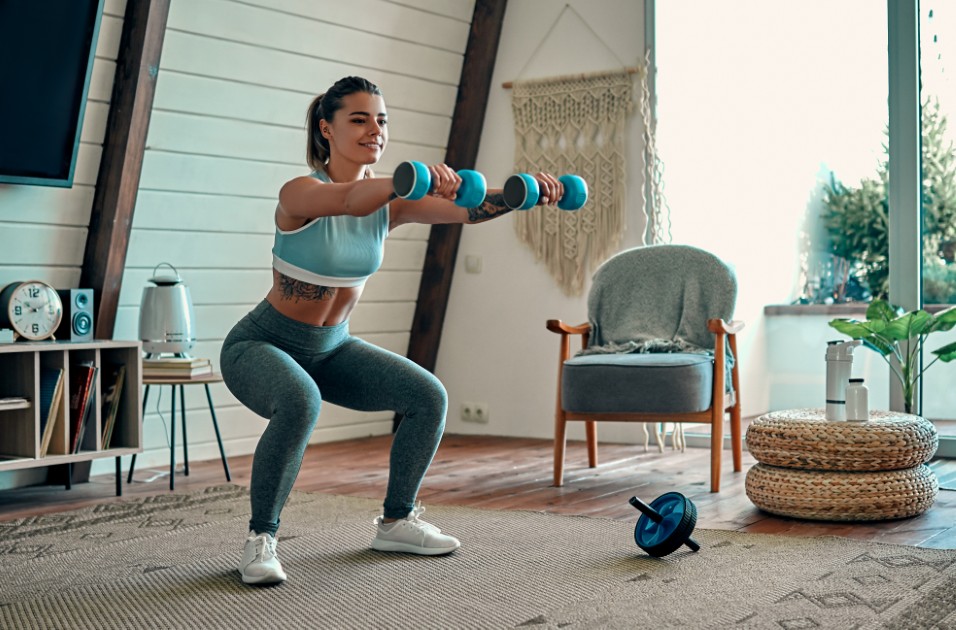
You’ve carved out 30 minutes. The dumbbells are right there. And yet, you find yourself doing a set of curls, wandering to squats, maybe a few push-ups, then wondering if you actually did anything useful. Sound familiar?
Random training gets random results. According to a 2022 review in the Journal of Strength and Conditioning Research, structured resistance programs — those built around consistent exercise sequencing and progressive overload — produce significantly greater strength gains than unplanned, ad hoc sessions over an 8-week period. The difference isn’t effort. Its design.
This article gives you a no-repeat, structured full-body workout you can run at home with a single set of dumbbells. No gym required. No wasted sets. Just a purposeful 30-minute strength block that hits every major muscle group — and a framework you can repeat, scale, and own.
Get more like this — weekly.
One email a week. Research-backed wellness, translated into things you can actually do. No spam.
Why Structure Changes Everything
Most beginners default to training by feel. They gravitate toward exercises they enjoy, avoid the ones that are uncomfortable, and repeat the same movements week after week. The result is imbalance — overdeveloped mirror muscles, undertrained posterior chain, and a plateau that arrives before real strength ever does.
Structured workouts solve this by removing guesswork. When your exercises are sequenced intentionally — pushing movements paired with pulling movements, lower body following upper body — you allow each muscle group to recover while another works. This is called antagonist pairing, and research from the National Strength and Conditioning Association (NSCA) confirms it reduces fatigue accumulation while maintaining training volume. In plain terms: you do more, feel less wrecked, and build more evenly.
Structure also creates a feedback loop. When you follow the same framework week to week, you can measure progress — adding a rep, increasing the dumbbell weight by 2.5 lbs, completing the same block 30 seconds faster. That data becomes motivation. And motivation becomes consistency.
The No-Repeat Full Body Strength Block (30 Minutes)
This workout is designed around six compound movements — one for each major movement pattern. Every exercise appears once, and every muscle gets trained. No filler. No redundancy.
Complete 3 rounds of the following circuit. Rest 45–60 seconds between exercises, 90 seconds between rounds. Choose a dumbbell weight where the last 2–3 reps of each set feel genuinely challenging.
The Six-Movement Block
- Goblet Squat — 10 reps (lower body push, quad-dominant)
- Dumbbell Romanian Deadlift — 10 reps (lower body hinge, hamstring and glute)
- Dumbbell Push-Up or Floor Press — 10 reps (upper body push, chest and triceps)
- Single-Arm Dumbbell Row — 10 reps each side (upper body pull, back and biceps)
- Dumbbell Reverse Lunge — 8 reps each side (unilateral lower body, balance and stability)
- Dumbbell Overhead Press — 10 reps (upper body push, shoulders and upper back)
Each movement targets a distinct pattern. Together, they create a complete training stimulus — no muscle left behind, no movement pattern neglected.
PRO TIP: Before your first round, spend 5 minutes on movement prep — a bodyweight squat, hip hinge to touch your shins, and arm circles. Research published in the Journal of Human Kinetics shows that dynamic warm-up routines improve strength output by up to 8% compared to jumping straight into loaded movement. Five minutes is all it takes.
How to Make Progress Week Over Week
A single great workout won’t transform your body. What transforms your body is repeating a great workout with slightly more demand each time. This principle — progressive overload — is the foundation of every effective strength program in existence.
For beginners, the NSCA recommends increasing training load by 2–5% once you can complete all sets and reps with clean form and the last two reps no longer feel challenging. With dumbbells, that often means jumping to the next dumbbell weight, adding a rep, or reducing your rest interval by 10–15 seconds.
Your 4-Week Progression Map
- Week 1: Learn the movements. Focus on form over load. 3 rounds, 45–60 sec rest.
- Week 2: Add 1 rep to each exercise or reduce rest by 10 seconds.
- Week 3: Increase dumbbell weight by the smallest increment available.
- Week 4: Add a 4th round. Your endurance and strength have both grown — use them.
Tracking your sessions matters here. You don’t need an app — a notes app or a single notebook page works. Write down the weight you used, the reps you completed, and how the last round felt. That record becomes your roadmap.
Three Mistakes That Stall Beginner Progress
Knowing the workout is only half the equation. Here are three patterns that derail beginners before they ever see results — and how to sidestep them.
1. Lifting Too Light to Create Adaptation
Comfortable weight doesn’t build strength. If your dumbbells feel easy through all three rounds, your muscles have no reason to adapt. Choose a load where the final two reps of each set require focus and real effort — but where your form stays clean. That’s your working weight.
2. Skipping the Hinge Movement
Most beginners skip or rush the Romanian deadlift because it feels unfamiliar. But the hip hinge is the single most important movement pattern for posterior chain development — the hamstrings, glutes, and lower back that protect your spine and power your entire body. Don’t skip it. Practice it slowly at light weight until the pattern clicks.
3. Training Inconsistently Instead of Imperfectly
Waiting for the perfect day, the perfect amount of sleep, or the perfect 45 minutes is a trap. A 20-minute version of this workout done consistently beats a perfect session done sporadically. Research in the International Journal of Sports Physiology and Performance consistently shows that training frequency is a stronger predictor of strength gains than session duration. Show up. Adjust. Keep going.
Your Strength Starts With One Structured Session
You don’t need a gym membership, a complicated program, or hours of free time to build real, lasting strength. You need a framework — a structured full-body workout that trains every movement pattern, respects your time, and gives you something to measure and improve.
This six-movement block is that framework. It’s designed for where you are right now: beginning, building, figuring out what works. Run it three times this week. Track your weights and reps. Then come back next week and do it slightly better than before.
That’s how strength is built — not in one dramatic session, but in the quiet accumulation of structured, intentional effort. Start today. Your future self is already training.



No one seems to have shared their thoughts on this topic yet
Leave a comment so your voice will be heard first.