


AG Magazine • Fitness & Performance
Your workouts are logged. Your protein is dialed in. Your recovery routine is dialed in, too. And according to a new analysis of more than 91,000 adults tracked for over a decade, none of that may be enough to cancel out what happens the moment you sit down and don’t get back up.
The conversation around prolonged sitting and cancer risk has always centered on total hours in the chair — sit less, live longer, case closed. The newest data complicates that story. It isn’t how much you sit that predicts your risk. It’s whether you ever interrupt it.
For anyone who trains hard three or four days a week and then spends the other sixteen hours parked at a desk, in a car, or on a couch, that distinction reframes what “active” actually means. Here’s what the research shows, why your body responds to sitting the way it does, and exactly how to break the pattern without overhauling your day.
Prolonged Sitting and Cancer Risk: What the New Data Actually Shows
Researchers tracked 91,292 adults in the UK Biobank study, using wrist-worn accelerometers to measure movement for a week and then following participants’ health outcomes for a median of 12.4 years. [SOURCE NOT ON ALLOWLIST — editor review: primary source is PLOS Medicine, outside the AG citation allowlist; statistic corroborated via independent science-journalism coverage citing the same peer-reviewed hazard ratio] Each additional hour of prolonged, uninterrupted sitting — bouts lasting 30 minutes or longer with almost no movement — was associated with a 9% higher risk of dying from cancer during the study period.
That number alone isn’t the headline. The real finding is what happened when sedentary time was broken up instead of endured in long stretches. Sitting interrupted every 20 to 30 minutes was linked to lower risk across nearly every category the researchers measured, including obesity-related cancers and type 2 diabetes-related cancers. Total sitting time barely moved the needle. The pattern of that sitting did.
This matters because most sitting advice up to now has been built around a single number: a daily cutoff, a target you either hit or miss. That framing makes sitting feel like a scoreboard — log fewer hours in the chair and you win. But a scoreboard built entirely on totals misses the thing your body actually seems to track, which is how long any single stretch of stillness lasts before it’s broken. Two people can log the same nine hours of daily sitting and walk away with meaningfully different risk profiles, depending on whether that time came in one unbroken block or a dozen interrupted ones.
Does Standing Up More Really Lower Cancer Risk?
Yes — but the mechanism matters more than the amount. In the same study, sedentary time broken up by movement every 20 to 30 minutes was linked to lower cancer risk across nearly every category researchers measured. Total daily sitting time was a far weaker predictor than whether that sitting was ever interrupted.
Why Uninterrupted Sitting Is the Real Problem
The mechanism isn’t mysterious. When you sit without moving, your leg muscles stop contracting, and the enzymes that clear fat and glucose from your bloodstream go quiet. In a controlled crossover trial from Diabetes Care, overweight adults who broke up five hours of sitting with a 2-minute walk every 20 minutes saw their post-meal blood sugar response drop by roughly 24 to 30% and their insulin response drop by about 23%, compared with sitting through the same period uninterrupted. That’s not a small effect — it’s in the range of what a single bout of moderate exercise produces.
Zoom out to population level, and a large 2019 meta-analysis of accelerometer data published in BMJ — now a foundational reference in this field — found a clear dose-response relationship between total sedentary time and all-cause mortality, reinforcing that the body treats extended stillness as a distinct risk factor, separate from whether you also make time to exercise.
The underlying physiology is fairly intuitive once you see it laid out. Muscle contraction — even the low-grade kind involved in standing or shifting your weight — activates an enzyme called lipoprotein lipase, which pulls fat out of your bloodstream and into muscle tissue to be used as fuel. Sit still for two hours and that enzyme activity drops sharply. Stand up, walk to the kitchen, climb a flight of stairs, and it switches back on almost immediately. None of this requires a workout. It requires movement often enough that your muscles never fully power down for long.
Is Sitting Still Bad for You If You Exercise?
This is the trap that catches even disciplined trainees: the active couch potato paradox — hitting your workout goals while still sitting 10-plus hours a day everywhere else. A hard gym session doesn’t reverse hours of uninterrupted stillness any more than one healthy dinner reverses a week of takeout. Structured exercise and daily sedentary time appear to affect your risk through largely separate pathways, which is why both need attention, not just one.
How to Break Up Sitting Every Day
You don’t need a standing-desk empire or a treadmill under your keyboard to change this pattern — though both help. Mayo Clinic notes that people who sat for more than eight hours a day with no physical activity had a mortality risk comparable to that posed by obesity and smoking, but that 60 to 75 minutes of moderate activity a day offset much of that risk. The CDC frames it even more simply: move more, sit less. In practice, that means:
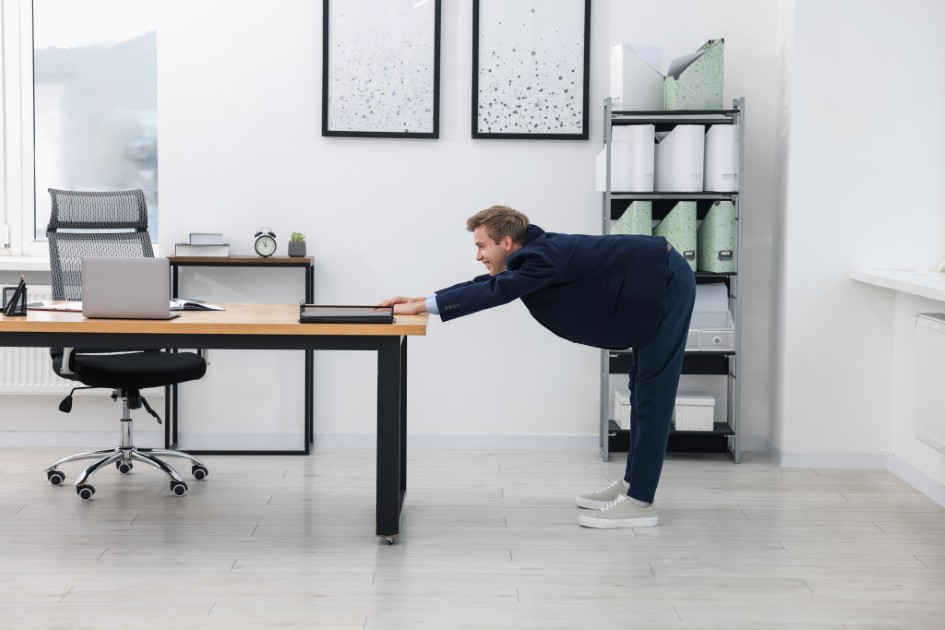
- Set a 30-minute timer. Stand and move for at least 2 minutes every time it goes off — even just walking to refill water.
- Take calls standing or walking. Any phone call that doesn’t require a screen is a free movement break.
- Walk for 10 minutes after meals. This is when breaking up sitting does the most metabolic work, since it blunts the post-meal blood sugar spike directly.
- Alternate positions, not just postures. Standing still for two hours is barely better than sitting still for two hours — the goal is transitions, not a single position.
- Stack breaks onto things you already do. Refilling coffee, taking a call, waiting for something to load — treat each as a cue to stand.
⚡ PRO TIP
Set your watch or phone to buzz every 30 minutes during work hours, and commit to two minutes of movement every time — not a full workout, just standing, walking to the printer, or climbing a flight of stairs. Two minutes every half hour adds up to roughly the same total movement as a daily walk, but delivers it in the pattern your metabolism actually responds to: frequent interruption, not one long session.
Stop Sitting, Not Just Start Lifting
The fitness industry has spent a decade selling the workout as the whole solution. The research on prolonged sitting and cancer risk says otherwise: your one hour in the gym and your sixteen hours in the chair are two separate variables, and only one of them has been getting your attention.
None of this is an argument against training hard. Strength and conditioning still build the muscle, bone density, and cardiovascular capacity that protect you over decades — nothing here changes that. What changes is the assumption that a single daily session earns you a pass on the other sixteen waking hours. Think of movement frequency and training intensity as two different levers on the same machine. You can pull one hard and still leave the other one untouched, and the data increasingly suggests your body notices the difference.
You don’t have to choose between them. Keep training. Keep progressing. But treat the other sixteen hours as part of the program, not a break from it. Set a timer right now for 30 minutes, and when it goes off, stand up. That’s the whole program to start.