

AG Magazine • Fitness & Performance
A five-minute movement break every hour changed someone’s energy levels more than an hour at the gym. That’s not a productivity hack anecdote. It’s an increasingly well-supported physiological finding — and it challenges one of the most ingrained assumptions in fitness culture: that exercise only counts when it’s long enough to justify the gym bag.
The problem with the modern fitness paradigm is not that people don’t value exercise. It’s that they’ve been conditioned to believe a workout must be 45–60 minutes to produce meaningful benefit. That belief, combined with full calendars and sedentary jobs, means millions of health-conscious people sit for 8–10 hours and then try to undo it with one concentrated training session. The physiology does not cooperate.
Movement snacks — brief, structured bouts of physical activity distributed throughout the day — are now supported by a growing body of research as a complementary or in some cases superior strategy for metabolic health, blood sugar regulation, cardiovascular function, and cognitive performance. A 2022 study in Nature Medicine found that replacing 30 minutes of sedentary time with even light physical activity was associated with a 34% reduction in all-cause mortality risk nature.com. Not intense exercise. Light movement, distributed.
This article explains the science behind movement snacks, what changes when you practice them consistently, and a practical daily protocol you can implement starting today.
The Science Behind Movement Snacks
The physiological case for movement snacks starts with what happens inside your body during prolonged sitting — because the problem is not merely the absence of exercise. It is the active metabolic disruption that sedentary behavior creates.
What Sitting Continuously Does to Your Metabolism
Within 20–30 minutes of continuous sitting, lipoprotein lipase — an enzyme critical for fat metabolism — begins to downregulate significantly. Muscle contractions in the legs are one of the primary triggers for this enzyme’s activity. Without them, circulating triglycerides increase, glucose uptake by muscle tissue decreases, and insulin sensitivity begins to decline. This is not a theoretical risk over the years. It is a measurable biochemical shift that begins within a single prolonged sitting bout, as documented in a foundational 2012 study in Diabetologia acpjournals.org.
This matters for your gym session too. If you sit for eight hours before a 6 p.m. training session, you are arriving metabolically compromised — with elevated circulating glucose, reduced fat oxidation capacity, and blunted insulin signaling. You are not starting from a neutral baseline. You are recovering from a full day of metabolic suppression.
How Movement Snacks Interrupt the Cycle
Movement snacks work by repeatedly activating the metabolic pathways that prolonged sitting suppresses. Even a two-minute walk or a set of 10 bodyweight squats every hour triggers muscle contractions sufficient to upregulate lipoprotein lipase activity, stimulate GLUT-4 glucose transporters in muscle cells, and restore a degree of insulin sensitivity diabetesjournals. The interruptions don’t need to be intense to be effective. They need to be frequent.
A 2023 systematic review in the British Journal of Sports Medicine analyzed 17 studies on exercise snacking and sedentary interruption. The consistent finding: distributing short bouts of activity throughout the day produced equal or superior improvements in postprandial glucose, blood pressure, and aerobic capacity compared to a single continuous session of equivalent total duration bjsm.bmj. Equal effort, significantly better metabolic distribution.
Movement Snacks vs. Continuous Training: What the Evidence Shows
This is not an argument for abandoning structured training. It is an argument for recognizing that structured training and movement snacking operate on different physiological timescales and address different problems. Your gym session builds capacity. Your movement snacks maintain the metabolic environment that makes that capacity accessible.
Blood Sugar Regulation: The Most Compelling Case
Postprandial blood sugar spikes — the glucose surge that follows a meal — are one of the most damaging metabolic events that occur repeatedly throughout a standard workday. A 2018 study in Diabetologia compared three conditions: sitting continuously, one 30-minute walk, and three 10-minute walks distributed across the day. The distributed walking reduced postprandial glucose peaks by 58% more than the single continuous session link.springer.com. The mechanism is straightforward: repeated muscle contractions throughout the day create repeated glucose uptake events, preventing the accumulation that a single exercise bout cannot fully address after the fact.
Cognitive Performance: The Underrated Benefit
Movement snacks also produce measurable cognitive benefits that a single morning gym session cannot sustain across a full workday. Research published in the Journal of Science and Medicine in Sport found that five-minute walking breaks every hour improved attention, executive function, and mood significantly more than unbroken sitting, regardless of whether participants had exercised earlier in the day jsams.org. The effect appears to be driven by increased cerebral blood flow and the acute neurochemical response to light physical activity — norepinephrine, dopamine, and BDNF (brain-derived neurotrophic factor) — all of which diminish during prolonged sitting and are restored within minutes of movement.
⚡ PRO TIP
Anchor your movement snacks to existing daily triggers rather than setting timers. Research on habit stacking from Stanford behavioral scientist BJ Fogg shows that attaching a new behavior to an existing reliable cue — standing up every time you send an email, doing 10 squats before every coffee — produces significantly higher long-term adherence than alarm-based reminders tinyhabits. The trigger is already there. You are just adding a two-minute movement layer to something you already do reliably. Over a standard 8-hour workday, four to six movement snacks of two to five minutes each adds up to 8–30 minutes of accumulated physical activity — without any calendar blocking required.
Building Your Movement Snack Protocol
The most effective movement snack protocol is the one that fits your actual day, not a theoretical ideal. Here is a tiered framework based on your work environment and current activity level, designed to be implemented without equipment and without disrupting your workflow.
Tier 1: Desk-Based (Minimal Space Required)
If you work at a desk and cannot easily leave your immediate area, these movement snacks require nothing but your own bodyweight and 90 seconds of floor space:
- Chair squats: Stand from your chair and sit back down slowly, 10 reps. Targets quadriceps and glutes, activates the largest muscle groups for maximum metabolic response.
- Calf raises: Stand behind your chair, 15–20 raises. Activates the calf muscle pump that assists venous return — directly counteracting the blood pooling associated with prolonged sitting.
- Desk push-ups: Hands on desk edge, 10–12 reps. Upper body activation that also elevates heart rate briefly, triggering the cognitive benefits of movement.
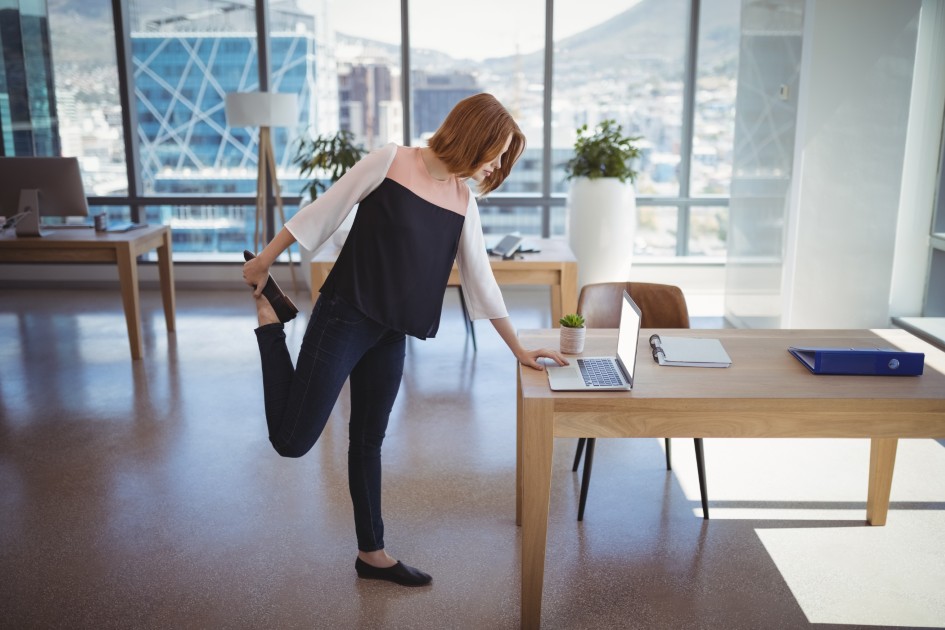
- Standing hip flexor stretch: 60 seconds each side. Hip flexors are the primary postural victim of prolonged sitting; brief stretching reduces the chronic tightness that accumulates across a workday.
Tier 2: Corridor or Outdoor Access
If you can step away from your desk for two to five minutes, the metabolic and cognitive benefits scale significantly:
- Brisk two-minute walk: The single most evidence-backed movement snack. Pace should be fast enough to feel slightly warm but not breathless.
- Stair climbing: Two to three floors at a moderate pace. Research in the International Journal of Environmental Research and Public Health found that stair climbing snacks of three minutes, three times per day, improved VO2max and lowered cardiovascular disease risk markers over six weeks mdpi.com.
- Bodyweight complex: 10 squats + 10 walking lunges + 10 push-ups, completed as a circuit once. Takes approximately three minutes and activates six major muscle groups.
How Movement Snacks Complement Your Training
A common concern is whether frequent low-intensity movement throughout the day will interfere with recovery from structured training. The evidence suggests the opposite. Light movement — particularly walking and gentle mobility work — enhances recovery by increasing blood flow to working tissues, clearing metabolic byproducts, and reducing the cortisol accumulation that sedentary stress generates.
Think of it this way: your structured training is where you build capacity. Your movement snacks are how you maintain the metabolic health that lets you express that capacity. One is a peak. The other is the baseline you return to between peaks. Both matter. Neither replaces the other.
Athletes who integrate movement snacks into their non-training days report reduced muscle stiffness, improved sleep quality, and better perceived recovery — outcomes consistent with what the research predicts from improved lymphatic circulation and reduced inflammatory markers associated with sedentary behavior reduction.
The Minimum Effective Dose for Movement Snacks
You do not need to move every 20 minutes to see a benefit. The research suggests a practical minimum: interrupting sedentary behavior at least every 60 minutes with two to five minutes of light-to-moderate physical activity. That is the threshold at which postprandial glucose, blood pressure, and cognitive function improvements become consistently measurable across the literature.
For most desk workers, four to six movement snacks per workday is the target. That is 8–30 minutes of accumulated movement on top of whatever structured exercise you already do. At the upper end of that range, you are meeting the physical activity guidelines issued by the World Health Organization for moderate-intensity movement — not by blocking gym time, but by reclaiming the metabolic activity your workday was silently eliminating.
What would it mean for your energy, focus, and long-term health if every workday included six moments of deliberate movement instead of eight hours of unbroken sitting? That is not a rhetorical question. It is the experiment the research is inviting you to run.
Start With One Snack. Build From There.
The movement snack model is not a replacement for serious training. It is the metabolic maintenance layer that makes serious training more effective. When you reduce the daily physiological damage of prolonged sitting, you arrive at each training session better prepared, recover faster between sessions, and build the kind of baseline fitness that compounds across decades rather than cycling through peaks and collapses.
The reframe is this: fitness is not something that happens during your workout. It is something that is either actively maintained or actively eroded by every hour of your day. Movement snacks are how you tip that balance in your favor, consistently, without adding a single item to your calendar.
Choose one movement snack — just one — and attach it to something you already do every day this week. A set of chair squats before your first meeting. A two-minute walk after lunch. Do it every day for seven days and notice what shifts in your energy and focus. Then add a second snack. The protocol builds itself.