

AG Magazine • Fitness & Performance
Ask ten lifters what the Copenhagen plank does and you’ll hear ten answers. Core. Obliques. Inner thighs. Some swear it fixes groin pain; others call it gym theater for people who enjoy suffering on a bench. Which is it? Either way, it keeps turning up in gyms and training plans, and the real answer is more interesting than either camp admits.
Here’s the curious part: the Copenhagen plank has a serious research trail. Sports medicine teams have measured it, tested it on real squads, and found that it ranks among the most demanding inner-thigh exercises. The hype is louder than the evidence in some places, and quieter in others.
Get more like this — weekly.
One email a week. Research-backed wellness, translated into things you can actually do. No spam.
This guide separates what the research supports from what the internet has stretched. You’ll learn which muscles the Copenhagen plank loads, what trials say about adductor strength and groin injury prevention, and how to start safely, whether you compete professionally or train for the long game.
What Is the Copenhagen Plank and What Does It Work?
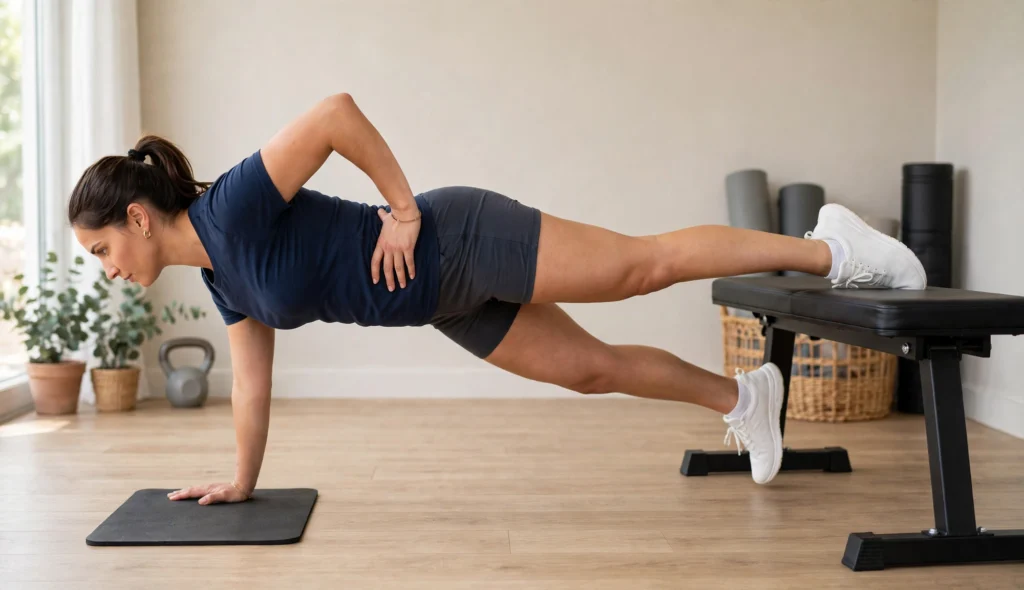
The Copenhagen plank is a side plank with your top leg supported on a bench while your bottom leg hangs free. It trains the hip adductors, the inner-thigh muscles, by making them hold your pelvis up against gravity. Researchers call it the Copenhagen adduction exercise.
That inner-thigh demand is real. In a foundational 2014 British Journal of Sports Medicine EMG study, researchers measured adductor longus activity in 40 elite male soccer players across eight hip adduction exercises. Activity ranged from 14% to 108% of a maximal voluntary contraction, and the Copenhagen adduction exercise ranked among the dynamic high-intensity options.
Why Is It Harder Than a Regular Side Plank?
In the Copenhagen plank, your supported top leg presses into the bench to keep your pelvis lifted, with no help from the floor. That’s a specific, concentrated demand on your hip adductors, and it’s why the move can feel humbling even for strong athletes.
If your inner thigh trembles within seconds, that isn’t failure. It’s information about where your hip strength currently stands.
What Does the Research Say About Adductor Strength?
Start with strength, because that’s where the evidence is firmest, and because players with low adductor strength appear to be at higher risk of injury. In a foundational 2016 randomized trial of 24 U-19 football players, an eight-week supervised Copenhagen adduction program increased eccentric hip adduction strength by 35.7%. The control group showed no significant change, and compliance topped 91%.
Eccentric strength is simply your muscle’s ability to control a load while it lengthens, the way you lower a weight slowly instead of dropping it. That’s the quality researchers measure, because it’s the one the exercise loads most directly.
The benefits extend into rehab. A 2024 randomized controlled trial of soccer players with adductor-related groin pain found that adding the exercise to rehabilitation improved eccentric hip adduction strength, lowered pain scores, and reduced self-reported disability.
Pulling the studies together, a 2021 systematic review reached a consistent conclusion: the exercise increases eccentric adduction strength and adductor muscle activity in male soccer players. That’s the part of the story you can trust most.
Does the Copenhagen Plank Prevent Groin Injuries?
Possibly, and the strongest evidence comes from one large trial. In a foundational 2019 cluster-randomised trial of 652 semiprofessional Norwegian football players, a one-exercise adductor program built on the Copenhagen adduction exercise lowered the risk of reporting groin problems by 41%. Earlier groin-prevention programs had not shown significant reductions.
Now the honest caveat. That result comes from male footballers and relied on self-reported symptoms. The 2021 review above adds that more research is needed to confirm a clear link between the exercise and injury prevention.
So treat the Copenhagen plank as a well-supported way to build adductor strength and a promising, not guaranteed, tool for groin injury prevention. If you’re older, newer to training, or returning from injury, scale the lever down and check with a clinician first.
Persistent pain deserves a real assessment, too. A 2015 international consensus statement recognized adductor-related pain as one of several defined clinical entities of groin pain in athletes, alongside iliopsoas-related, inguinal-related, and pubic-related pain. More planks won’t fix every cause.
Who Benefits Most From Copenhagen Planks?
The research centers on football because groin problems are common there. The 2019 trial’s authors note that two out of three groin injuries in football are adductor-related, and that low hip adduction strength is an important, modifiable risk factor.
Is the Copenhagen Plank Only for Soccer Players?
No, though the proof is thinner outside football. The same authors point out that low hip adduction strength is also considered a risk factor in sports with similar movement patterns, such as ice hockey, rugby, and Australian rules football. Whether the benefit carries over to women, youth players, or the highest professional level is not yet known.
For everyone else, the takeaway is practical rather than promised. If your sport or training involves kicking, cutting, or skating, building adductor strength is a sensible goal, even without a guarantee against injury. Does your current program train your inner thighs at all?
How Do You Start Doing Copenhagen Planks Safely?
Treat this exercise like a heavy lift: earn each step. Most trial participants were young male athletes, so progress deliberately and let these five takeaways keep you honest.
- Start with a short lever. Rest your top knee on the bench instead of your ankle. A shorter lever lowers the load while you build control.
- Keep one straight line. Elbow under shoulder, hips stacked, head neutral. If your hips sag, make the exercise easier.
- Hold briefly, finish clean. Short, controlled holds beat long, shaky ones. End the set when your form breaks.
- Add lever, not time. Progress from knee to shin to ankle as control improves, rather than chasing longer holds.
- Stop on sharp pain. Muscular effort in your inner thigh is expected. Sharp or pinching groin or hip pain is your cue to stop.
How Often Should You Do Copenhagen Planks?
The 2019 trial offers a reference point. Players performed the exercise three times per week during a six-to-eight-week preseason, then once per week through a 28-week competitive season, using three progression levels they could scale to their symptoms.
Think of that as a model, not a prescription. Begin with once or twice per week, then build toward that pattern as your control improves. The same trial reported no adverse events related to the exercise, but it didn’t track them systematically.
⚡ PRO TIP
Film one hold from the front. Your pelvis should stay level and your hips stacked. If your lower hip drops or you twist, move the bench support from ankle to knee and try again. Clean reps at an easier lever give you something solid to progress from.
Hold the Line. Earn the Progression.
The Copenhagen plank earned its reputation honestly. It’s a carefully studied exercise that builds adductor strength and shows real promise for groin protection, without being magic. It rewards patience, honest form, and sensible progression.
So here’s the reframe: the goal isn’t the hardest version. It’s the version you can repeat with control, week after week, until your hips feel like they belong to a stronger athlete. Will you chase the show-off variation, or build the one that lasts?
Your adductors rarely ask for attention until they complain. Give them a plan before that day arrives.
This week, film one knee-supported hold on each side, note which side stays steadier, and schedule your next two sessions.


No one seems to have shared their thoughts on this topic yet
Leave a comment so your voice will be heard first.