
Feeling wrecked? Trade today’s workout for 20 minutes of gentle joint work.
You don’t have to “earn” your rest days by suffering through them. When your body feels tight, overworked, or just tired of being tired, soft mobility is your secret weapon. Think of it as active kindness for your muscles and joints—especially if you’re over 30, over 50, or a stressed lifter stacking long workdays on top of heavy training.
This is still training—just a different brushstroke in your Fitness as Art. Small, low‑impact movements keep you mobile, help you unwind, and quietly support Stronger Bodies, Stronger Lives over the long game.
Why Gentle Mobility Belongs on Your Rest Days
Mobility ≠ , forcing yourself into pretzel shapes. It’s simply moving your joints through a comfortable range of motion, slowly and with control.
Research from Harvard Health notes that stretching and mobility work keep muscles flexible, strong, and healthy so you can maintain a full range of motion at your joints; when you skip it, muscles shorten, tighten, and become more injury‑prone when you ask them to work hard again.health.harvard.edu
The American College of Sports Medicine (ACSM) recommends flexibility work at least 2–3 days per week, with the greatest gains coming from near‑daily practice. Static stretches are typically held 10–30 seconds for adults, and 30–60 seconds can be especially helpful for older adults. health.harvard.edu
Gentle mobility on “off” days can help you:
- Reduce stiffness and soreness by improving circulation and nutrient delivery to tired tissues
- Maintain joint health and function across your lifespan, especially in weight‑bearing joints like hips, knees, and spine
- Support balance and postural control, which becomes more important as you move through your 40s, 50s, and beyond
Low‑impact movement is not “doing nothing”—it’s active recovery: you’re helping your body clear fatigue so you can come back stronger. health.clevelandclinic.org
Static vs Dynamic: What Kind of Mobility on Rest Days?
On training days, experts generally suggest dynamic stretching before workouts and static stretching after—moving stretches to warm up, held stretches to cool down, and relax the nervous system.
Rest days are different. You’re not prepping for high output—you’re helping your system downshift. That’s where slow dynamic mobility + gentle static holds shine:
- Slow dynamic moves (like controlled arm circles or leg swings) help lubricate joints and boost circulation without spiking heart rate.
- Comfortable static holds signal “safety” to your body, helping muscles release tension and easing chronic tightness or back pain.
The sweet spot: 10–20 minutes of easy, pain‑free movement that leaves you feeling calmer and more open—not smoked.
7 Gentle Mobility Moves to Unstick Your Whole Body
You can do this as a 20‑minute flow or sprinkle a few moves as “movement snacks” throughout the day—short bursts of 2–5 minutes that break up sitting and reduce stiffness. marieclaire.co.uk
Move slowly, breathe through your nose if you can, and never force range. Your rest day is not the time to grind.
1. Diaphragmatic Breathing + Pelvic Tilts (Back & Nervous System)
- Lie on your back, knees bent, feet flat.
- One hand on chest, one on belly. Inhale into your lower ribs; exhale slowly.
- On each exhale, gently tuck your tailbone to flatten your low back into the floor, then release.
Why it helps: Deep breathing plus small pelvic motion calms your nervous system and gently mobilizes the lumbar spine—especially helpful if you sit a lot or lift heavy. uhs.berkeley.edu
2. Cat–Cow (Spine Flexibility Without Stress)
- On hands and knees, wrists under shoulders, knees under hips.
- Inhale: let your belly drop, lift chest and tail (Cow).
- Exhale: round your spine, tuck chin and tail (Cat).
Flow for 8–10 slow breaths.
Why it helps: Takes your spine through flexion and extension in a low‑load position, easing stiffness from heavy squats, deadlifts, or long drives. Gentle spinal mobility like this is widely used in programs to ease chronic back discomfort. uhs.berkeley.edu
3. 90/90 Hip Rotations (Hips That Actually Move)
- Sit with your front leg bent at ~90° in front of you, back leg bent 90° behind (both knees on the floor if possible).
- Gently lean forward over the front shin for a stretch; then rotate your torso toward the back leg.
- Switch sides after 5–8 slow breaths.
Why it helps: Hip internal and external rotation are essential for pain‑free walking, squatting, and lunging—especially as you age. Targeted hip mobility can improve joint comfort and help manage early stiffness or osteoarthritis symptoms. bswhealth.com
4. Thoracic “Open Book” (Upper Back & Desk Relief)
- Lie on your side, hips and knees bent 90°, arms straight out in front, palms together.
- Inhale, then slowly open the top arm across your chest, rotating your upper back while your knees stay stacked.
- Follow your hand with your eyes. Exhale, return to start. Repeat 6–8 reps per side.
Why it helps: Rotation in your mid‑back offsets all the rounded‑shoulder, forward‑head positioning from screens. Better thoracic mobility supports healthier shoulders and easier breathing.
5. Shoulder Circles & Wall Slides (Joint‑Friendly Shoulder Care)
- Stand tall. Draw slow circles with your shoulders and straight arms (like big, controlled arm circles).
- Then, stand with your back and forearms against a wall, elbows at 90°. Slide your arms up and down, keeping ribs down.
Why it helps: Controlled movement through the shoulder joint boosts synovial fluid (your joint “oil”) and maintains overhead mobility—critical for pressing, swimming, and daily tasks like reaching shelves. health.harvard.edu
6. Ankle Circles + Calf Stretch (Ankles for Lifters & Walkers)
- Sit or stand and make slow, full circles with one ankle, 10 each direction.
- Then, in a gentle calf stretch against the wall or step, hold 20–30 seconds per side.
Why it helps: Healthy ankle dorsiflexion (bending your ankle) is non‑negotiable for deep squats, comfortable walking, and balance. Low‑impact exercise and mobility work are key tools for protecting ankle and knee joints over time.
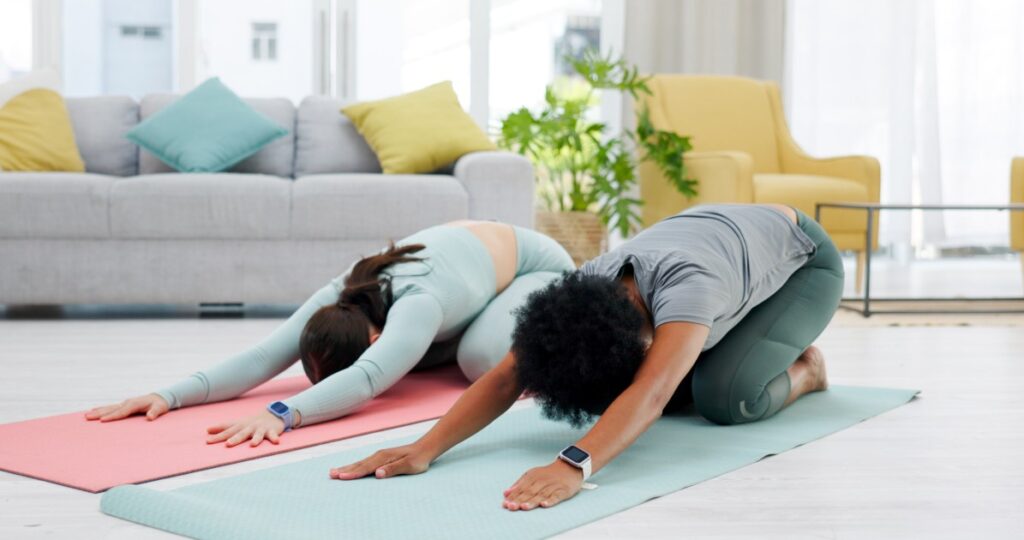
7. Child’s Pose with Side Reach (Hips, Low Back, Nervous System)
- From hands and knees, sit your hips back toward your heels, arms reaching forward.
- Breathe into your sides and low back.
- Walk your hands to one side for 3–5 breaths, then to the other.
Why it helps: A classic yoga shape that gently opens the hips and lengthens the spine while down‑regulating your nervous system. Great before bed or after a stressful day.
How to Turn This Into a 20‑Minute Recovery Ritual
Here’s a simple Rest‑Day Mobility Flow:
- Diaphragmatic breathing + pelvic tilts – 3 minutes
- Cat–Cow – 2 minutes
- 90/90 hip rotations – 4 minutes (2 per side)
- Open book – 3 minutes
- Shoulder circles + wall slides – 3 minutes
- Ankle circles + calf stretch – 3 minutes
- Child’s pose with side reach – 2 minutes
That’s ~20 minutes of soft, low‑impact work. No timer obsession needed—move slowly, breathe, and let your body tell you when it’s had enough.
Pro Tip: On workdays, use micro‑sessions as “movement snacks”—2–5 minutes of one or two moves every hour instead of doom‑scrolling. Research suggests these small bursts throughout the day help combat stiffness, improve mood, and support long‑term health. marieclaire.co.uk
Special Notes for Over‑30, Over‑50, and Stressed Lifters
- You recover differently now. As we age, recovery from intense exercise takes longer; gentle mobility and low‑impact movement help keep joints happy without adding more stress.
- Long‑term joint health > short‑term ego. Organizations like the Arthritis Foundation emphasize that regular, joint‑friendly activity improves range of motion, muscle strength, and overall joint comfort—even if you already have arthritis.
- Stretching isn’t just “extra.” Expert panels highlight that consistent stretching and mobility work improve flexibility and may reduce soreness, enhancing performance in everyday activities like walking or cycling.
You’re not going soft—you’re getting smart. Movement is Storytelling, and on rest days, the story is this: “I respect my body enough to help it recover.”
Your Next Move: Trade One Workout for 20 Minutes of Ease
You don’t have to overhaul your whole program. Start simple:
- Pick 3–4 moves from the list.
- Do them tonight for 10–15 minutes instead of another doom‑scroll or extra junk volume.
- Notice how your shoulders, hips, and back feel tomorrow when you train again.
If your goal is long‑term performance, longevity, and a body that still feels good at 40, 50, 60+, soft mobility isn’t optional—it’s part of the art.
This week, schedule two 20‑minute soft mobility sessions on your calendar—just like a workout. Protect that time. Let it be quiet, kind, and low‑pressure. Your joints, your lifts, and your future self will all thank you.