

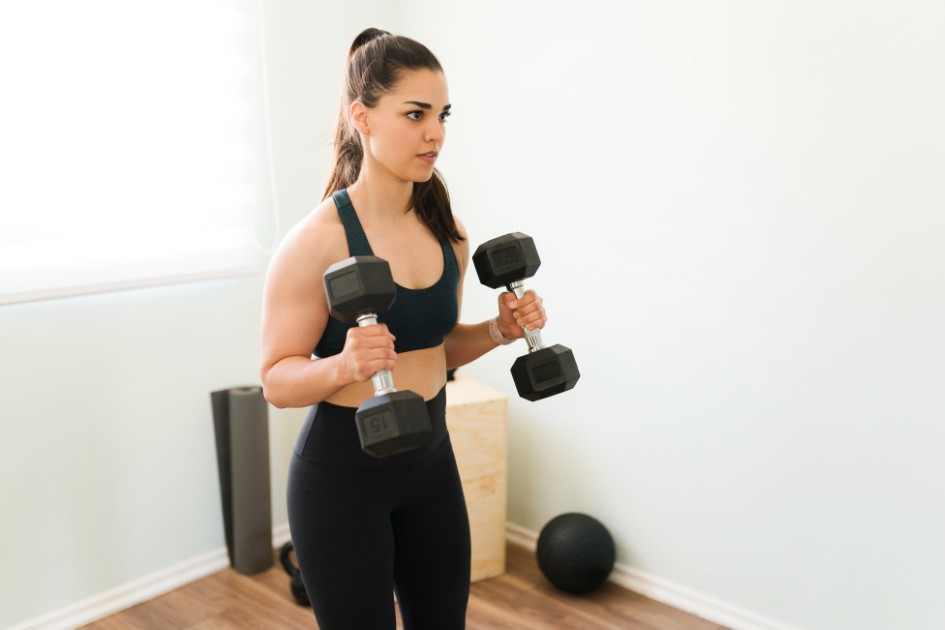
30 minutes. 16 moves. No repeats. Full-body strength training—done. If that sounds like the kind of efficient, boredom-proof workout you need, read on. As a new year begins, many of us are looking for fresh fitness challenges to stay motivated. Yet studies show roughly 80% of New Year’s resolutions fail by February kynetex.com, often due to boredom or unrealistic routines. The solution? Infuse your workouts with challenge, novelty, and time-efficiency. A no-repeat dumbbell strength circuit checks all those boxes: it keeps you engaged, fits into 30 minutes, and delivers serious results. In this article, we’ll explain what a no-repeat dumbbell circuit is, why it’s so effective, and how you can start one to kick off your New Year on a strong note.
What Is a No-Repeat Dumbbell Strength Circuit?
A no-repeat dumbbell strength circuit is a type of circuit training workout where you never perform the same exercise twice in one session. In a traditional circuit, you rotate through a sequence of exercises (hitting different muscle groups) with minimal rest. Most circuits involve repeating that sequence for multiple rounds healthline.com. No-repeat circuits throw out the repetition: you design a longer list of exercises (for example, 10–20 different moves) and do each only once for a set time or reps, one after the other.
This approach gives you a full-body workout in a single continuous circuit. You’ll typically alternate upper- and lower-body moves as you go, which allows one muscle group to recover briefly while you work another. For instance, after a set of dumbbell push presses for shoulders, you might drop into goblet squats for legs, then a bent-over row for back, and so on. There’s little to no idle time—by the time you finish all the moves, you’ve hit every major muscle. Because no exercise repeats, the variety is huge and your mind stays engaged. One fitness coach put it plainly: it’s “pretty hard to get bored during a circuit workout”—especially a no-repeat one. In just half an hour, you can combine strength and cardio moves and be done with your full-body training for the day.
No-repeat dumbbell circuits are popular for home workouts and bootcamp-style classes because they require minimal equipment (just a few dumbbells or adjustable weights) and they turn exercise into a fun, fast-paced challenge. Instead of dreading multiple sets of the same lift, you know once you finish an exercise, you’re onto the next. This creates a sense of momentum and novelty that makes the time fly by. It’s a challenging format, no doubt—but also highly rewarding when you power through all those distinct exercises and realize you’ve completed an intense workout in only 30 minutes.
Why Try a No-Repeat Circuit? Benefits and Results
This unique training style offers numerous advantages, making it ideal for kicking off your New Year fitness journey. Some key benefits include:
- Time-Efficient Full-Body Workout: Circuit training is famously time-efficient, packing both strength and cardio into one session. With minimal rest and exercises targeting all major muscle groups, you can get a comprehensive workout in around 30 minutes healthline.com. In fact, research shows that high-intensity circuits can yield strength and muscle gains comparable to traditional weight training – in much less time per session. In one study, trained women increased their strength and lean muscle just as much with circuit-style training as with conventional lifting, while the circuit group’s workouts were significantly shorter in duration.
- Builds Strength and Cardiovascular Endurance: A no-repeat dumbbell circuit will have you lifting weights while keeping your heart rate elevated. This means you’re simultaneously improving muscular strength and cardiorespiratory fitness pmc.ncbi.nlm.nih.gov. Over time, you can increase lean muscle and boost your heart health through this style of training. One systematic review concluded that resistance circuit workouts promote concurrent improvements in strength and aerobic endurance, while also helping decrease body fat. In other words, you get stronger and fitter at the same time. Your heart, lungs, and muscles all benefit from the sustained effort.
- High Calorie Burn for Fat Loss: Constant movement with minimal rest means your body burns a lot of calories during the workout. Since your heart rate stays elevated almost the entire time, you’re torching a high volume of calories in a short period. Plus, because you’re using dumbbells (i.e. doing resistance training), your metabolism stays revved up for hours after you finish. This “afterburn” effect (from EPOC, excess post-exercise oxygen consumption) means you continue burning extra calories as your body recovers. Not surprisingly, circuit-style programs have been shown to reduce body weight and BMI in people with overweight. If fat loss or weight management is a goal, a no-repeat circuit can be a potent tool in your arsenal – it combines cardio and strength for maximal metabolic impact.
- Never Boring – Keeps You Motivated: If workout boredom has derailed you before, this approach is a game-changer. “One of the main reasons people stop exercising is that they get bored,” notes Christine Spain, director of research at the President’s Council on Fitness and Sports. A no-repeat circuit eliminates repetitive sets, so every single exercise is new. The constant variety keeps your mind engaged and actually makes workouts more enjoyable. Research backs this up: a University of Florida study found that participants following a varied exercise program enjoyed their workouts significantly more and stuck with the program longer than those who did the same exercise each session. In the study, the group with variety was 15% more likely to adhere to their routine than the monotony group. The message is clear – variety boosts consistency. Circuit training in general is great for this because you’re always moving to the next move with little time to get bored. You can even change up the circuit each time you work out, keeping things fresh and fun, which further increases your chances of sticking to it long-term.
- A Fresh Challenge to Kickstart the New Year: Trying 16 different exercises in one go tests your body in new ways and builds mental toughness. It’s a novel challenge that can reignite your enthusiasm at the start of the year, when motivation is high but needs to be sustained. Instead of the “same old” routine, you’ll be learning or revisiting a bunch of moves and pushing yourself to conquer each one. That sense of accomplishment after powering through a no-repeat circuit can be a huge confidence booster. In fact, exercise is known to release mood-lifting endorphins and increase self-efficacy (your belief in your ability to succeed). So when you crush a challenging circuit, you’re left feeling empowered and proud – the perfect mindset to carry into your next workout and into other goals. Embracing a tough-but-fun challenge like this can set a positive tone for the rest of your fitness journey. It’s hard, yes, but also empowering – and you might even find yourself smiling (between gasps for air) because exercise feels exciting again.
Getting Started: What You Need and How to Prepare
One of the beauties of a dumbbell circuit is that you don’t need much to get going. Here’s how to set yourself up for success:
- Minimal Equipment: All you need is a pair of dumbbells (or two pairs of different weights for variety) and some open space. No machines or fancy gear required. Dumbbells are extremely versatile – often called the “Swiss Army knife” of fitness – allowing you to perform a huge range of exercises for both upper and lower body nuoathletics.com . With just a couple of weights, you can effectively train every major muscle group. If you’re at home, a mat or carpeted area is helpful for floor exercises, and a stable chair or bench can serve as a step or support for certain moves. Keep a bottle of water and a towel nearby because you will break a sweat!
- Warm Up First: Before diving into the intense circuit, do a quick 5-minute warm-up to prepare your body. This should include dynamic movements that loosen up your joints and raise your heart rate. For example, you can do arm circles, hip circles, torso twists, leg swings, and a round of jumping jacks or jog in place goldsgym.com. The goal is to get blood flowing to your muscles and gently rehearse some motions you’ll be doing. Warming up helps improve your performance and reduce injury risk.
- Choose an Appropriate Weight: Select dumbbell weights that challenge you but allow you to maintain good form throughout each exercise. In a circuit, you won’t be able to lift as heavy as you might for a single-set strength exercise, because you’re not resting much. A good rule of thumb: use a weight at which the last 5–10 seconds of a 45-second exercise feel difficult (your muscles are burning), but you’re not outright failing or compromising form. If in doubt, start a bit lighter. You can always increase weight next time as you get stronger. For certain bodyweight moves (like burpees or mountain climbers), no added weight is needed. Remember, the pace and minimal rest make it intense even with moderate weights.
- Focus on Form and Safety: When doing a fast-paced circuit, it’s easy to get sloppy as fatigue builds up. Make a conscious effort to maintain proper form on each exercise, even when you’re tired. Quality beats quantity – 8 good reps are better than 15 reckless ones. Keep your core engaged to protect your spine on moves like squats, presses, and deadlifts. If you feel your form faltering, slow down or pause briefly. According to fitness experts, maintaining good posture throughout every exercise is essential, as improper form increases the risk of injury goldsgym.com. It’s better to take an extra few seconds rest or do slightly fewer reps than to push through with bad form. Also, be mindful of your surroundings; clear any hazards since you’ll be moving around.
- Listen to Your Body: Circuit training is tough. It’s normal to be breathing heavy and have burning muscles, but you should not feel dizzy or in pain (beyond normal muscle fatigue). Stay hydrated – grab quick sips of water during longer rest intervals or as needed. If you ever feel lightheaded, hit the pause button and rest until you recover. You can always modify the workout to your fitness level: for example, do 30 seconds per exercise instead of 45, or allow 20-30 seconds between moves instead of 10. Over time, as your stamina increases, you can ramp up the intensity by shortening rests or adding weight. The mantra here is “challenge yourself, but respect your limits.” Consistency matters more than pushing too hard on day one.
Lastly, set up a timer or interval app to keep you on track during the circuit. Planning the workout beforehand (we’ve got an example below) and having a timer beep when it’s time to switch exercises will make the session run smoothly. Crank up some motivating music, and get ready to sweat!
The 30-Minute No-Repeat Dumbbell Circuit Workout
A no-repeat dumbbell circuit incorporates a variety of dynamic exercises. For example, here one move combines an upper-body dumbbell raise with a step-up, engaging multiple muscle groups at once.
Ready to put it all together? Below is an example 16-move no-repeat dumbbell circuit you can try. This workout hits all your major muscle groups from head to toe in one continuous sequence. Perform each exercise for about 45 seconds, then take around 15 seconds to transition to the next move (just enough time to catch your breath and get into position). Aim to go straight down the list with minimal rest. After the last exercise, you’ll have completed roughly 16 minutes of active work. Including a warm-up (5 minutes) and a cooldown (5 minutes of stretching or light movement), the whole session comes in at about 30 minutes.
Example No-Repeat Dumbbell Circuit (16 Exercises, 45s each):
- Goblet Squat – Hold one dumbbell at your chest, feet shoulder-width apart. Squat down and up. Targets: Quads, glutes, core.
- Bent-Over Dumbbell Row – Hinge at the hips with a flat back, hold dumbbells, pull elbows back to row, then extend arms. Targets: Back (lats), biceps.
- Dumbbell Push Press – From a standing position, hold dumbbells at shoulder level. Do a quick quarter-squat and drive up, pressing weights overhead using your legs and shoulders. Targets: Shoulders, triceps (with a power cardio element).
- Reverse Lunges (Alternating) – Hold dumbbells at your sides, step one foot back into a lunge, then alternate legs. Targets: Legs (glutes, quads), balance.
- Dumbbell Floor Press – Lie on your back (on floor or bench) with dumbbells. Press them up from chest like a bench press. Targets: Chest, triceps.
- Romanian Deadlift – Stand holding dumbbells in front of thighs. Keeping your back straight, hinge at the hips to lower weights towards mid-shin, then squeeze glutes to stand up. Targets: Hamstrings, glutes, lower back.
- Dumbbell Biceps Curls – Stand with dumbbells at your sides, palms facing forward. Curl the weights up toward your shoulders, then lower. Targets: Biceps.
- Overhead Triceps Extension – Stand holding one or two dumbbells overhead (grip them securely). Bend at the elbows to lower the weight behind your head, then extend arms back up. Targets: Triceps (back of arms).
- Lateral Lunges (Alternating) – Hold dumbbells and start standing. Step out to the right side, bending the right knee and keeping left leg straight, then push back up. Alternate sides. Targets: Inner and outer thighs, glutes.
- Dumbbell Thrusters – Hold dumbbells at shoulders, do a full squat, and as you stand up, press the dumbbells overhead in one fluid motion. Targets: Full body (legs, shoulders, core); this is a tough compound move that really elevates the heart rate.
- Plank Renegade Rows – Get into a push-up plank position with hands on dumbbells. Alternately pull one dumbbell up to your ribcage (row) while balancing on the other hand/feet, then switch. (Modify on knees if needed.) Targets: Back, biceps, core, shoulder stabilizers.
- Russian Twists – Sit on the floor holding one dumbbell with both hands. Lean back slightly and lift your feet (if you can). Rotate your torso to tap the dumbbell on the floor to one side, then the other side, repeating in a controlled twisting motion. Targets: Abdominals (especially obliques).
- Dumbbell Swing – Similar to a kettlebell swing but using one dumbbell. Stand with feet shoulder-width. Hold the dumbbell with both hands and swing it between your legs by hinging your hips, then thrust hips forward to swing the weight up to about chest height. (Use momentum from your hips; do not lift with your arms.) Targets: Glutes, hamstrings, core, shoulders (and cardiovascular conditioning).
- Mountain Climbers (Bodyweight) – Get into a plank and “run” your knees to your chest one at a time, as fast as you can, while maintaining a flat back. Targets: Core, shoulders, cardio.
- Dumbbell Woodchoppers – Hold one dumbbell with both hands. Start with it up by one shoulder, then perform a chopping motion down diagonally across your body to the opposite hip (pivoting feet as needed). Do 3–4 chops on one side, then switch sides halfway through the 45 seconds. Targets: Core (obliques), shoulders, hips.
- Burpees (Bodyweight) – From standing, squat down, jump your feet back into a push-up position, optionally perform a push-up, then jump feet back in and explode up into a jump clap overhead. (To modify, step back into plank and skip the push-up/jump.) Targets: Full body (legs, chest, arms, core) and an excellent cardio finisher to max out your heart rate.
Perform each exercise for 45 seconds, resting ~15 seconds between them (just move quickly to set up the next exercise). If 45 seconds per move is too intense at first, start with 30 seconds work / 30 seconds rest. Conversely, if you’re advanced and crave more challenge, push to 60 seconds per exercise with minimal rest. After you finish #16, take a breather! Walk around for a minute to cool down, then do some light stretching for all major muscle groups. You’ve just completed a full-body gauntlet of strength and endurance. Feel free to repeat the entire circuit if you have extra time and energy – but remember, the idea was to get great results without needing endless rounds. Even a single round of this 16-move circuit will leave you winded, and your muscles thoroughly worked.
For best results, try incorporating this no-repeat circuit into your weekly routine regularly. For example, you might do it 2–3 times per week on non-consecutive days. As the weeks go by, aim to increase the difficulty slightly – use a bit heavier dumbbells, or shave a few seconds off your rest periods, or add a couple of new exercises to keep it interesting. Track your progress (maybe note how many reps of each exercise you get in 45 seconds) so you can see your improvements in strength and stamina. Above all, focus on consistency and effort.
Conclusion: Embrace the Challenge
The No-Repeat Dumbbell Strength Circuit is more than just a workout – it’s a mindset of tackling new challenges and breaking out of your comfort zone. By combining challenge, novelty, and efficiency, this training style helps you get fit faster and have fun doing it. You’ll reap the benefits of improved strength, endurance, heart health, and likely a better mood and confidence to boot, healthline.com. And with the constantly changing exercises, you’re far less likely to lose interest or skip workouts – meaning you can finally stick to that New Year fitness plan beyond February.
So, as you embark on your New Year fitness journey, consider giving the no-repeat circuit a try. It’s perfect for anyone who wants maximum results in minimum time, without the boredom of a repetitive gym routine. Remember to start smart, listen to your body, and celebrate the small wins (like mastering a new move or increasing your weight).
Now grab your dumbbells and get to it – you can crush a full-body, heart-pumping workout in just 30 minutes, no repeats required. Challenge yourself to finish this circuit and see how accomplished you feel afterward. This new year, no more stale workouts or abandoned resolutions. It’s time to build strength, boost your energy, and keep things exciting. Ready to get started? No repeats – no excuses! Go ahead and conquer this circuit challenge, and let the results speak for themselves. Good luck and have fun!