

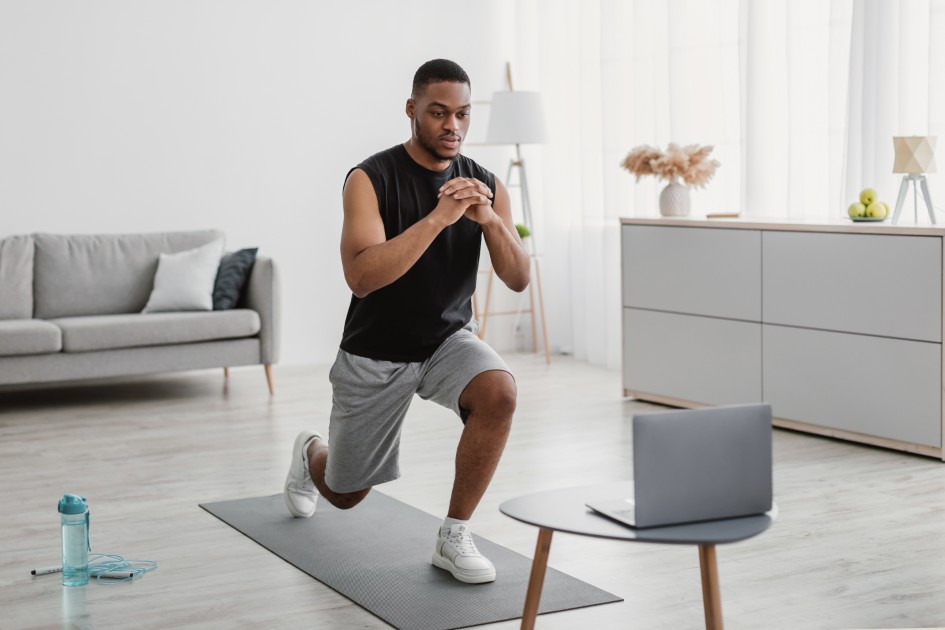
If your deep squat feels blocked or your splits never progress, you may not need “more stretching.” You likely need hip rotation + end‑range strength + controlled joint motion—because usable mobility is what you can access actively, not just passively. Chronic stretching improves range of motion (ROM), but resistance training (done through a full ROM) can improve ROM too—often comparably—supporting the case for “strength‑based mobility,” not stretch‑only routines. link.springer.com
This article gives you a no‑equipment, ~20‑minute hip-focused reset (CARs + split and deep‑squat drivers), designed for days you feel wrecked: trade today’s workout for gentle joint work—and come back better tomorrow. The routine uses evidence-backed flexibility dosing (multiple brief exposures) and puts rotation back on the menu. abom.org
Why your hips need more than stretching
Deep-range goals are joint goals. A deep squat isn’t only “flexible hips”—it’s a coordinated blend of ankle dorsiflexion, knee flexion, hip flexion, pelvic control, and trunk positioning. A motion-analysis study found relationships between squat depth variables and joint ROM—especially ankle dorsiflexion ROM as a predictor of squat ankle dorsiflexion angles, with inter-limb (contralateral) effects that can hide the real limiter.
Splits are not one stretch—they’re positions you must control.
Front splits require hip extension (rear leg) plus hamstring length/tolerance (front leg) and pelvic control; side splits require adductor length/tolerance and hip abduction capacity. Stretching helps, but if you can’t generate tension and control at end range, you’ll feel “loose” yet still blocked.
Contrarian truth: Many people chase more passive stretching when what they’re missing is rotation and strength in the “corners.” Resistance training can increase ROM, undermining the fear that lifting makes you “tight.” link.springer.com
What the science says about hips, ROM, and performance
Flexibility training guidance commonly targets ≥2 days/week and about 60 seconds total per muscle–tendon group (accumulated in shorter holds). Harvard Health similarly recommends accumulating about 60 seconds per stretch using repeats, and advises holding with mild tension (not bouncing). health.harvard.edu
Long-term stretch training improves ROM, and training variables (like total time and frequency) matter. But a major meta-analysis found chronic resistance training increases ROM as well, and can be as effective as stretching—supporting mobility work that blends active control and load. link.springer.com
For “warm-up vs cooldown” decisions: static stretching can slightly reduce explosive performance, while dynamic stretching tends to improve it; a network meta-analysis reported dynamic stretching produced more stable improvements in explosive performance outcomes. bjsm.bmj.com
Finally, stretching alone isn’t the strongest injury-prevention lever; a BJSM systematic review/meta-analysis found consistently favorable estimates for many prevention measures except stretching, reinforcing that strength + control is the backbone, with mobility as support.
The hip reset flow
Use case (hook): Feeling wrecked? Swap today’s workout for ~20 minutes of gentle joint work—then return to training with better positions.
Equipment: none (a wall/chair is optional for balance).
Intensity: 3–6/10 (you should finish feeling better, not destroyed).
Key rule: “Mild tension, not pain; don’t bounce.” health.harvard.edu
| Time | Drill | Step-by-step cues | Beginner option | Advanced option |
| 2:00 | 90/90 breathing + pelvic tilts | Inhale low (ribs expand), long exhale; gently tilt pelvis through small range | Lie on back, feet on floor | Add 3 end-exhale pauses |
| 4:00 | Hip CARs (2:00/side) | Slow circle: knee up → out → back → down; keep pelvis quiet; move only the hip | Smaller circles; hold wall | Add 2–3sec pauses at “corners” |
| 3:00 | 90/90 shin-box switches | Sit tall; rotate knees side to side smoothly; don’t jam hips | Hands behind you | Hover hands; slower tempo |
| 3:00 | Adductor rock-backs | Hands/knees wide; rock hips back until inner thigh tension; exhale | Narrow stance | Add 2-sec end-range holds |
| 4:00 | Half-kneeling hip flexor + rotation (2:00/side) | Squeeze rear glute; ribs down; gentle forward shift; rotate toward front leg | Smaller range; pad under knee | Add 5-sec “drag” isometric (rear knee forward) |
| 4:00 | Deep squat pry + ankle rocks | Feet rooted; sit deep; elbows inside knees; rock ankles/knees forward over toes | Hold doorframe; heels elevated slightly | Add 3 slow breaths at bottom |
Why CARs belong here (without the hype): Controlled rotations are essentially active end-range practice—a way to explore and “own” your hip’s available ROM. While CARs themselves aren’t heavily trialed as a branded method, the underlying principle—active control at end range—aligns with evidence that resistance training and full-ROM work improves ROM.
Split and deep-squat “drivers” you should train
Think in drivers, not random stretches:
Deep squat drivers – Ankles: limited dorsiflexion often forces heel lift or compensations; ankle ROM strongly relates to squat angles in motion analysis. jstage.jst.go.jp
– Hips + trunk: rotate and control, not just loosen. Use 90/90 + deep squat pry to map your shape.
Splits drivers – Front split: rear‑hip extension + front‑hamstring tolerance.
– Side split: adductor tolerance + hip abduction control.
A practical contrarian tactic: add strength at long lengths (gentle isometrics in the stretched position) instead of only passive holds—consistent with evidence that loaded/full-ROM approaches can improve ROM.
Safety notes and red flags
Mobility work should feel like tension and warmth, not pinching or sharp pain. If you feel a deep groin “pinch” in hip flexion or pain that worsens with squatting, consider evaluation: femoroacetabular impingement (FAI) involves extra bone and can cause pain during deep hip flexion, like squatting. orthoinfo.aaos.org
Also remember: cartilage is avascular and relies largely on diffusion from synovial fluid; cyclic loading and movement can influence nutrient transport—supporting the common-sense idea that regular joint motion is healthy input (within tolerance).