

AG Magazine • Culture & Lifestyle
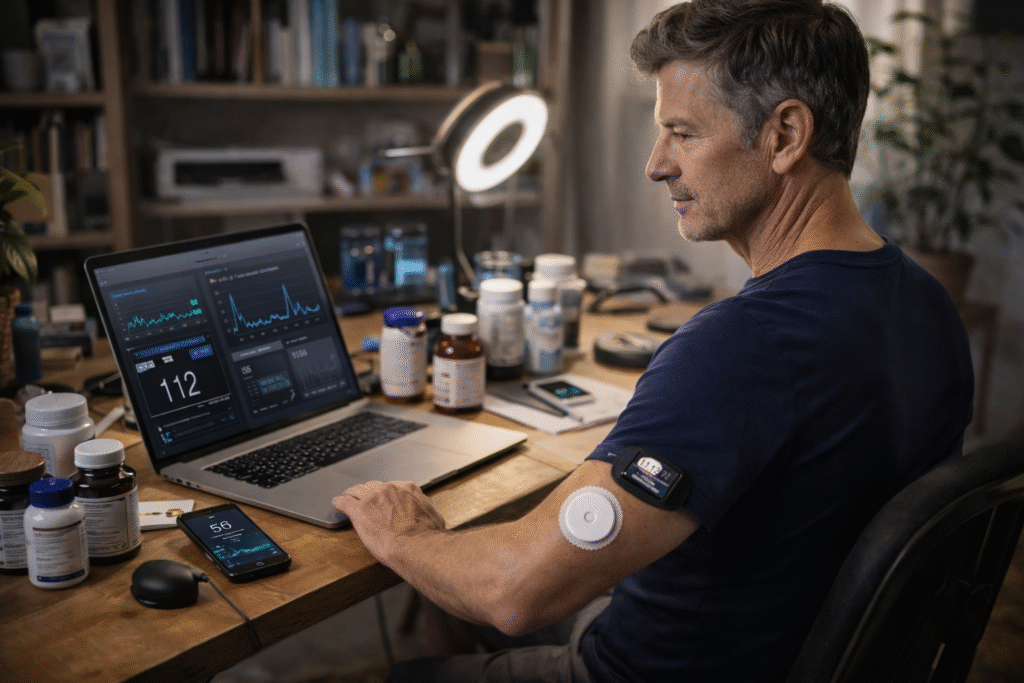
Six months of cold plunges at 5 a.m. A continuous glucose monitor on your arm. HRV scores are checked before you’ve said good morning to anyone. Seventeen supplements laid out in precise order. And somehow, you feel worse than before you started.
This is the biohacking paradox. The tools designed to give you control are quietly stealing something more valuable: the ability to feel okay without data confirming it. For a growing segment of health-conscious achievers, biohacking obsession has crossed from performance edge into compulsion territory.
A 2021 study in the Journal of Behavioral Addictions found that excessive health-monitoring behaviors share structural features with obsessive-compulsive patterns — including anxiety spikes when access to tracking is removed. akjournals.com The pursuit of optimal health, unchecked, can become its own form of chronic stress. And chronic stress is precisely what you were trying to eliminate.
This article isn’t a case against biohacking. It’s a case for doing it smarter. Here’s what the research says about where optimisation tips into obsession — and the practical framework for pulling yourself back to the productive side of that line.
The Optimisation Paradox: More Data, More Anxiety
There is a concept in psychology called “information overload,” and it doesn’t just affect productivity — it affects health decisions in ways that actively undermine wellbeing. When you monitor every biomarker simultaneously, your nervous system has to process a continuous stream of potential threats. Is your HRV down this morning? Is your sleep score a 74 when it was 81 last week? Each data point becomes a micro-stressor.
A landmark 2019 study published in JAMA Internal Medicine examined patients given access to detailed health tracking versus those given standard care. The tracking group reported significantly higher health anxiety without meaningfully better health outcomes. jamanetwork.com More information did not produce more confidence. It produced more vigilance.
The irony is biologically precise: elevated cortisol from monitoring anxiety suppresses the immune function, impairs sleep quality, and reduces recovery capacity — the exact metrics most biohackers are trying to improve. You’re generating the stress you’re trying to measure your way out of.
When Tracking Becomes a Crutch
The warning sign isn’t how many devices you own. It’s how you feel without them. If a dead battery on your sleep tracker genuinely ruins your morning — not because you missed data, but because you feel unsafe without the number — that’s the line. You’ve transferred your internal sense of well-being to an external device. The tool is now running for you.
The Hidden Cost of Health Perfectionism
Researchers at the University of York coined the term “orthorexia nervosa” to describe a pathological obsession with “clean” or “correct” eating that causes significant distress and impairs daily functioning. springer While orthorexia was initially applied to dietary behavior, sports psychologists have increasingly observed the same cognitive architecture in high-intensity biohackers — an unyielding focus on perfect inputs that paradoxically degrades quality of life.
The clinical threshold matters here. Not everyone who tracks macros or monitors sleep has orthorexic tendencies. The diagnostic criteria center on impairment: Does it interfere with social functioning? Does violating the protocol generate disproportionate anxiety? Does the pursuit of health feel punitive rather than empowering?
If you’ve turned down a dinner with people you care about because the menu didn’t fit your protocol, or felt genuine shame after a missed cold plunge, the optimization is no longer serving you. It’s costing you.
The Diminishing Returns Curve
Exercise science has long understood the concept of overtraining syndrome — where increasing training load beyond the adaptive threshold produces regression, not improvement. The same curve applies to self-optimization broadly. A 2020 meta-analysis in Sports Medicine confirmed that beyond a certain threshold of monitoring and intervention intensity, additional protocols produce diminishing physiological returns while psychological burden increases. springer More is not always more. Sometimes, more is the problem.
What the Anti-Biohacking Backlash Gets Right
The pushback against biohacking culture isn’t Luddism. It’s a reasonable response to a real phenomenon. Behavioral scientists at Stanford have documented what they call “quantified self fatigue” — a measurable drop in motivation and wellbeing in long-term self-trackers who initially reported high engagement. academic The novelty of data wears off. What remains is obligation.
Critics of biohacking culture also point to a socioeconomic distortion: the tools are expensive, the time investment is substantial, and the community culture can skew toward anxiety-driven perfectionism rather than resilient, adaptable health. When the goal shifts from feeling strong and capable to achieving a specific HRV number, something important has been lost in translation.
The backlash isn’t saying stop tracking. It’s saying track with intention, not compulsion. There is a meaningful difference between using data to inform decisions and using data to feel temporarily safe from uncertainty. One is a tool. The other is a coping mechanism.
⚡ PRO TIP
Run a 7-day “data detox” every 8–12 weeks. Put your wearable in a drawer, eat intuitively, train by feel. Research published in Psychological Science found that removing external feedback periodically strengthens interoceptive awareness — your ability to accurately read internal body signals. psychologicalscience.org Athletes who regularly practice training without data report improved perceived exertion calibration and greater long-term adherence. The goal isn’t to never track. The goal is to not need the tracker to function.
A Smarter Framework: Biohacking With a Minimal Effective Dose
The most effective biohackers aren’t the ones with the most devices. They’re the ones who have identified the fewest interventions that produce the greatest returns, and then stopped adding. This is the minimal effective dose (MED) principle applied to self-optimization — borrowed from pharmacology and championed by performance researcher Tim Ferriss, though its clinical roots run deeper.
Applying MED to your biohacking stack means regularly auditing what’s actually moving your performance needle versus what’s feeding the feeling of doing something. These are not the same thing. One produces measurable outcomes. The other produces busyness with the aesthetic of optimization.
Your Biohacking Audit: Four Questions
Run each protocol in your current stack through this filter:
- Does this intervention have evidence behind it at the dose I’m using, or am I extrapolating from unrelated research?
- Can I measure a meaningful outcome from this specifically, or is it bundled with ten other variables?
- How do I feel when I skip this for a week? Marginally different, or genuinely compromised?
- Am I doing this because it serves my goals, or because stopping feels uncomfortable?
Any protocol that fails questions three and four — where cessation generates anxiety rather than simply a neutral gap — is worth examining not as a health tool but as a behavioral pattern.
The Biohacking Obsession Recovery Plan
Getting back to intentional optimization is a three-phase process. It doesn’t require abandoning every tracker and supplement. It requires re-establishing why you started and whether the current stack actually serves that purpose.
Phase 1: Consolidate (Weeks 1–2)
Identify your top three health priorities. Not the twelve things your biohacking community says are essential — your three. Everything in your current stack that doesn’t directly serve one of those three priorities gets paused for 30 days. Not permanently. Just paused, so you can see what actually changes.
Phase 2: Recalibrate (Weeks 3–4)
During the pause, practice what sports psychologists call “subjective performance rating” — journaling how you actually feel across energy, mood, recovery, and focus without referencing device data. A 2022 study in the International Journal of Sports Physiology and Performance found that subjective well-being scores are as predictive of athletic performance as objective biomarkers across most trained populations. journals.humankinetics.com Your internal data is more sophisticated than you’ve been crediting it.
Phase 3: Rebuild Selectively (Week 5 onward)
Re-introduce only the interventions that passed the four-question audit. Build back in one at a time, 2–3 weeks apart, so you can actually see the effect of each addition. This is how you build a biohacking practice that compounds instead of one that simply escalates.
The Best Biohack Is Knowing When to Stop
High performance isn’t built on perfect HRV scores and immaculate supplement timing. It’s built on consistency, adaptability, and a relationship with your body that doesn’t collapse the moment your tracker battery dies. The data is a tool. You are the system.
The research is unambiguous: chronic optimization anxiety impairs the very biomarkers you’re measuring. The most elite performers across endurance, strength, and cognitive domains share one undervalued trait — the ability to perform well in imperfect conditions, because they’ve built genuine physical and psychological resilience, not just optimized metrics. psychologicalscience.org
This week, pick one protocol you’ve been running on autopilot and ask honestly: is this serving me, or am I serving it? Your answer is the most important biohack you’ll run all year.