

AG Magazine • Tech & Innovation
You wake up certain you slept seven and a half hours. Your watch says six hours and 49 minutes. Which one do you trust?
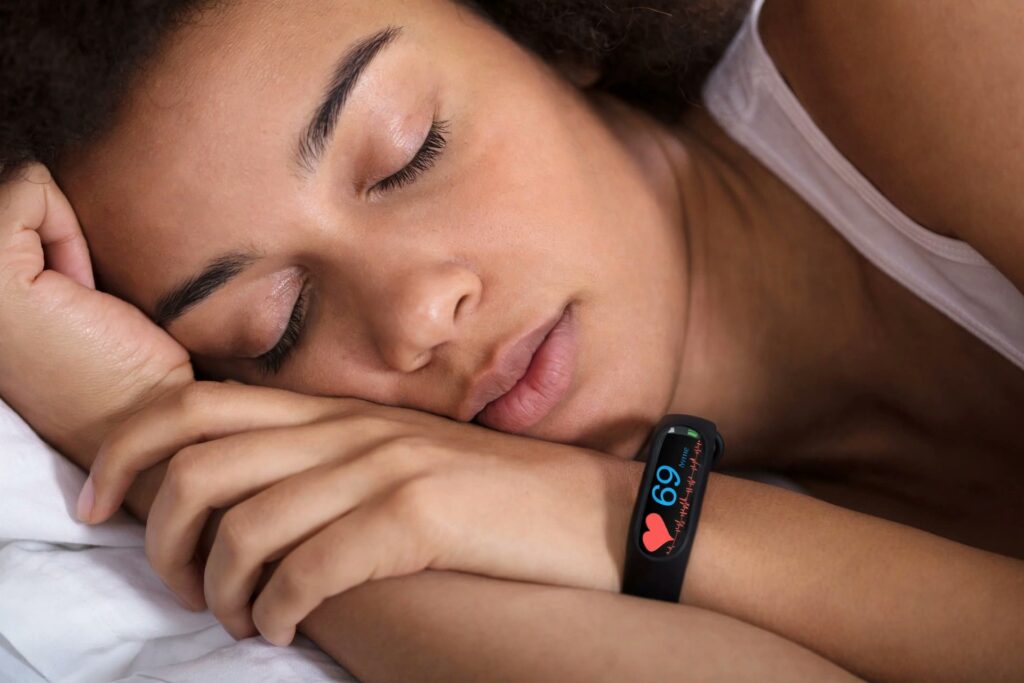
That tension sits at the center of perimenopause sleep research. In a poster presented at The Menopause Society 2026 Annual Meeting, as reported by Contemporary OB/GYN, 190 perimenopausal women over-reported their total sleep time by a mean of 35.3 minutes compared with their Fitbit. The medians told the same story: 7 hours 25 minutes reported, 6 hours 49 minutes tracked.
Get more like this — weekly.
One email a week. Research-backed wellness, translated into things you can actually do. No spam.
Neither number is simply the truth. Below, you’ll see why the two disagree, what each one gets wrong, and how to combine wearable sleep data with your own self-reported sleep to train, recover, and plan with confidence.
What Does Perimenopause Sleep Data Actually Show?
Perimenopause sleep data show that what women remember and what a wearable records often differ. In one 2026 poster, women reported roughly 35 more minutes of sleep than their Fitbit logged and about 31 fewer minutes awake overnight. The two measures rose and fell together, but they did not match.
How Big Was the Gap, and How Solid Is the Evidence?
The researchers paired a daily morning survey with 14 nights of Fitbit data from women aged 36 to 60, producing 2,537 paired samples. Self-reported and Fitbit total sleep time were strongly correlated (ρ = 0.67), so the women weren’t wildly off. Wake time was the bigger blind spot: the median self-reported time awake after falling asleep was 10 minutes, while Fitbit logged 46.
Read it with care. This was a conference poster, not a full peer-reviewed paper, and the women were recruited through a consumer health platform because they reported hot flashes or sleep problems. Night to night, the spread was enormous: the difference on 95% of nights landed anywhere from about 81 minutes under to 152 minutes over. And the poster compared Fitbit with self-report, not with a lab sleep study, so it can’t say which one is closer to reality.
Why Does Perimenopause Sleep Feel Better Than It Measures?
Researchers haven’t settled why self-reported sleep runs rosier than the device, and the evidence points in several directions. A 2018 review in Sleep Medicine Clinics led by Fiona Baker notes that lab-measured sleep doesn’t necessarily line up with how people rate their own sleep, and that psychological state can shape those ratings.
Hot flashes add another layer. In the same review, one study estimated that hot-flash-related wake time accounted for about 27% of objectively measured time awake after sleep onset, with wide variation between women. Your night may be more fragmented than it feels, or it may not be. Perimenopause symptoms vary too much for a single rule.
Can You Trust the Watch, Either?
Before you toss the app and trust your gut, here’s the twist: wearables have blind spots too, and sleep tracker accuracy is far from settled. A foundational 2019 review in Medicine & Science in Sports & Exercise found that consumer devices detect sleep with high sensitivity, above 90% in the studies reviewed, but are weaker at detecting wake. That tends to overestimate total sleep time and underestimate time awake.
Read that twice. Your memory and your watch may both lean toward “I slept more than I did.” It’s possible the real overnight picture is rockier than either one shows. That’s a hypothesis, not a finding of the poster, but it should keep your trust in any single number loose.
Is My Fitbit Accurate During Perimenopause?
Nothing here proves it is or isn’t. Fitbit sleep tracking, like any consumer device, depends on the algorithm and the person, and the same 2019 review calls the evidence base inconsistent. What the 2026 poster does show is a measurable gap you can learn to read, and learning to read it beats arguing about which gadget is right.
There’s one more practical wrinkle. The review’s authors note that device algorithms are proprietary and can change without notice, and they advise against swapping devices mid-study. Treat your tracker as a trend line, not a verdict.
Why Is Perimenopause Sleep So Hard to Read?
How Common Are Sleep Problems in Perimenopause?
Very common. In a study in the journal Menopause of nearly 48,000 women across the US and Europe, 61.7% of US perimenopausal women with hot flashes or night sweats reported sleep disturbances. Among those without them, 38.0% did.
Sleep trouble shows up with or without the classic perimenopause symptoms, which is one reason a single log rarely tells the whole story. It also means your wearable sleep data may be recording a night shaped by factors you never feel, from temperature swings to brief awakenings.
Why Do Averages Hide Your Pattern?
A May 2026 update from the Harvard T.H. Chan School of Public Health analyzed 94,118 nights of Apple Watch data. Participants spent about 0.8% more of their sleep time awake after menopause than before, roughly four extra minutes in an eight-hour night.
That sounds small. But the researchers found many participants had much larger increases while others had no meaningful change. Population averages describe the crowd. Your own two-week record describes you.
How Do You Close the Sleep Perception Gap?
Because sleep tracker accuracy varies, use both sources, in the right order. These five steps turn wearable sleep data and your own memory into one clear picture:
- Guess first, glance second. Write down your estimate of sleep time and night wakings before you open the app. Your self-reported sleep is data too.
- Log 14 mornings. Clinicians often ask people with sleep trouble to keep a sleep diary for a couple of weeks. A paired log gives you your personal gap.
- Watch the gap, not just the score. A steady 20-minute gap is calibration. A gap that widens or flips deserves attention. Stick with one device so the trend stays comparable.
- Cool and consistent. The Harvard team’s suggestions include a cool bedroom and a consistent bedtime and wake time, weekends included.
- Escalate smartly. If poor sleep persists, take your log to a clinician. Cleveland Clinic calls CBT-I the first-line treatment for insomnia and reports that 7 to 8 out of 10 people improve significantly. Loud snoring, heavy daytime exhaustion, or soaking night sweats are also worth a conversation.
Train on the pair. If you lift, run, or compete, the gap has a practical payoff. On mornings when both your log and your watch say the night was rough, treat it as a cue to dial back intensity, not a verdict on your fitness. When they disagree, let your warm-up referee: if movement feels crisp and your heart rate settles normally, proceed. If it feels heavy, trim the session. Either way, you decided with two pieces of evidence instead of one.
⚡ PRO TIP
Tomorrow morning, before you touch your phone, write three numbers: how long you think you slept, how many times you woke, and a 1–10 rating of how rested you feel. After 14 days, subtract your watch’s numbers from yours. A steady gap is calibration. A widening gap is the conversation to bring to your clinician.
Reclaim the Signal. Trust the Pair.
The 35-minute gap isn’t proof that you’re wrong or that your watch is. It’s proof that sleep is something you feel, remember, and measure, and each lens catches what the others miss. What if the smartest move isn’t picking a winner at all?
Perimenopause sleep will keep shifting, but reading it doesn’t have to be guesswork. Treat Fitbit sleep tracking, or any wearable, as a second opinion and your own log as the first. Tonight, set a phone reminder to write down your sleep estimate before you check your watch tomorrow, then repeat for 14 mornings. This article is educational, not medical advice, so bring persistent sleep trouble to your clinician.


No one seems to have shared their thoughts on this topic yet
Leave a comment so your voice will be heard first.